ALLEN-BRADLEY X1771N-0VVVVVVVZ High Resolution Isolated Analog Module
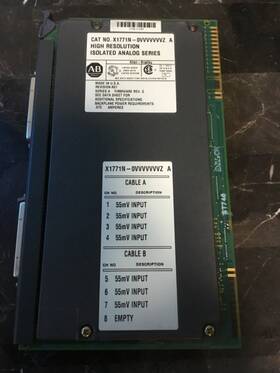
( Brand: Allen-bradley ), ( Manufacturer Part Number: X1771N-0VVVVVVVZ ), ( Type: High Resolution Isolated Analog Series ), ( Analog/digital: Analog )
Review ALLEN BRADLEY High Resolution Isolated Analog Series Module
The **Allen-Bradley X1771N-0VVVVVVZ** is a high-performance, isolated analog input module designed to integrate seamlessly into the **CompactLogix** and **ControlLogix** families of programmable logic controllers (PLCs), offering unparalleled precision and reliability for industrial automation applications. Part of Rockwell Automation s **1700 Series**, this module features **high-resolution analog input functionality**, delivering exceptional accuracy and stability for monitoring a wide range of process variables such as temperature, pressure, flow, and position signals. With a **16-bit resolution** (equivalent to 0.0009766% of full scale), the X1771N-0VVVVVVZ ensures fine granularity in data acquisition, making it ideal for applications requiring precise control and monitoring, such as manufacturing, energy management, and HVAC systems.
The module is **fully isolated** with **2500V RMS input-to-output isolation**, ensuring protection against electrical noise, ground loops, and voltage spikes that could compromise system integrity. This isolation not only enhances safety but also allows for the connection of signals from multiple sources without interference, making it suitable for harsh industrial environments where electrical disturbances are common. The **0-10V DC** input range (with configurable scaling) provides flexibility in interfacing with a variety of sensors, including RTDs, thermocouples (via compatible signal conditioners), and standard voltage or current loops, while the **16-channel configuration** (depending on the specific variant) maximizes input density for compact, high-density control panels.
Built with **industrial-grade components**, the X1771N-0VVVVVVZ is engineered to withstand extreme operating conditions, including temperature ranges from **-20 C to 60 C** and humidity levels up to **95% non-condensing**, ensuring reliable performance even in demanding environments. The module s **backplane-powered design** eliminates the need for external power supplies, simplifying installation and reducing system complexity. Additionally, its **plug-and-play compatibility** with **RSLogix 5000** and **Studio 5000** software platforms allows for straightforward programming, configuration, and diagnostics, enabling engineers to quickly set up and monitor analog inputs with minimal downtime.
For enhanced functionality, the X1771N-0VVVVVVZ supports **floating-point scaling**, **linearization**, and **filtering**, enabling precise signal conditioning to match the characteristics of specific sensors. Its **diagnostic capabilities** include built-in fault detection for open circuits, short circuits, and signal range violations, providing real-time alerts to prevent equipment damage and production disruptions. Whether deployed in a **discrete manufacturing facility**, a **process control system**, or a **smart grid infrastructure**, this module delivers the **speed, accuracy, and robustness** required to maintain optimal operational efficiency in modern industrial automation. With its **compact form factor**, **high isolation standards**, and **superior signal integrity**, the X1771N-0VVVVVVZ stands as a cornerstone for next-generation control solutions.
### **Pros and Cons of buying a Allen-Bradley X1771N-0VVVVVVZ (High-Resolution Isolated Analog Module)**
#### **Pros:**1. **High Precision and Resolution**
The X1771N module provides high-resolution analog input (typically 16-bit or higher), ensuring accurate measurement of small signal changes. This is ideal for applications requiring fine control, such as process automation, scientific research, or precision manufacturing.
2. **Isolation for Safety and Noise Immunity**
The module features isolation between the input and the PLC/control system, reducing the risk of ground loops, electrical noise, and potential damage from voltage spikes. This enhances system reliability, especially in industrial environments with harsh electrical conditions.
3. **Compatibility with Allen-Bradley PLCs**
As a Rockwell Automation product, it integrates seamlessly with Allen-Bradley PLCs (e.g., ControlLogix, CompactLogix, or Micro800), simplifying programming and communication via standard protocols like DH-485 or Ethernet/IP.
4. **Wide Input Range and Flexibility**
The module supports multiple input ranges (e.g., 10V, 0 5V, 4 20mA), allowing it to interface with various sensors and transducers without requiring additional signal conditioning.
5. **Rugged and Industrial-Grade Design**
Built to withstand harsh environments, the module is typically rated for temperature extremes, vibration, and EMI/EMC resistance, making it suitable for factory floors, outdoor installations, or marine applications.
6. **Scalability and Modularity**
Allen-Bradley s modular design allows easy expansion of I/O systems. If additional analog inputs are needed later, more modules can be added without major system overhauls.
7. **Support for Advanced Features**
Some variants of this module may include features like:- **Multiplexing** (for shared sensor use).
- **Built-in filtering** (to reduce noise).
- **Diagnostic capabilities** (e.g., fault detection for open/short circuits).
These features improve system performance and maintenance efficiency.
8. **Long-Term Availability and Support**
As a legacy but widely used product, spare parts and technical support are likely to remain available for years, reducing long-term obsolescence risks.
---
#### **Cons:**1. **Legacy Technology (Potential Obsolescence)**
The X1771N series is part of Allen-Bradley s older modular I/O platform (e.g., 1756 series). While still functional, newer PLCs (e.g., CompactLogix 5380, ControlLogix 5580) may favor more integrated or Ethernet-based I/O solutions, which could limit future scalability or require additional adapters.
2. **Limited Digital Communication Options**
Compared to modern Ethernet/IP or wireless I/O modules, the X1771N relies on traditional serial (DH-485) or proprietary backplane communication. This can introduce latency or complexity in distributed systems.
3. **Higher Cost per Module**
While the module itself may not be expensive, the need for additional components (e.g., I/O chassis, backplane cables) can increase the total system cost. Newer, more integrated solutions (e.g., Ethernet I/O modules) may offer better cost efficiency for new projects.
4. **Physical Size and Installation Constraints**
The module occupies space in a rack or chassis, which may be less compact than plug-and-play Ethernet I/O modules. In space-constrained applications, this could be a drawback.
5. **Software Dependency on Legacy Platforms**
Programming and configuration may require older versions of RSLogix or Studio 5000, which could pose challenges if the maintenance team lacks experience with these tools. Newer platforms (e.g., Studio 5000 Logix Designer) may offer more intuitive interfaces.
6. **Limited Expansion for High-Density Needs**
If a large number of analog inputs are required, multiple modules and chassis may be needed, increasing complexity and potential points of failure.
7. **Potential for Compatibility Issues**
While designed for Allen-Bradley PLCs, integrating it with non-Rockwell systems (e.g., Siemens, Schneider) may require additional gateways or protocol converters, adding cost and complexity.
---
### **Conclusion:**The **Allen-Bradley X1771N-0VVVVVVZ** is a robust, high-precision analog input module well-suited for industrial applications requiring isolation, accuracy, and compatibility with Allen-Bradley PLCs. Its strengths lie in its reliability, noise immunity, and seamless integration with legacy systems. However, its reliance on older technology, limited communication options, and potential long-term support concerns make it less ideal for greenfield projects or modernized automation setups.
### **Recommendation:** - **Buy if:**- You are maintaining or upgrading an existing Allen-Bradley system where this module is already in use or required for compatibility.
- Your application demands high-resolution analog inputs (e.g., process control, laboratory automation) and isolation is critical.
- You prioritize long-term availability and have a team familiar with legacy Rockwell platforms.
- **Avoid if:**- You are starting a new project and can opt for newer Ethernet/IP or wireless I/O modules (e.g., Allen-Bradley 1756-I/O modules or CompactLogix Ethernet I/O).
- Your budget allows for more integrated or scalable solutions that reduce wiring complexity and improve future flexibility.
- You need advanced features like remote I/O, cloud connectivity, or built-in edge computing, which are better supported by modern modules.
For new installations, consider evaluating **Allen-Bradley s newer 1756-I/O modules** (e.g., 1756-AIB for analog inputs) or **Ethernet-based solutions** (e.g., 1756-EN2T for remote I/O) to balance cost, scalability, and future-proofing. If the X1771N is already part of your system or a critical component, it remains a sound choice for its intended use.
Details:
G, Back plane Requirements: .975 Amperes Allen-Bradley X1771N-0VVVVVVVZ Series A High Resolution Isolated Analog Module Revision A01 Firmware Rev.
part #: x1771n0vvvvvvvz price
- $1500.00
specifications sensoindustria:
- brand: Allen-bradley
- mpn: X1771n-0vvvvvvvz
- type: High Resolution Isolated Analog Series
- analog/digital: Analog
returns sensoindustria:
- time: 14 Days
- policy: Returns Accepted
- method: Money back
- paid by: Buyer
shipping sensoindustria:
- carrier: USPS
- type: Calculated
- transit: 5-11 Days
- class: Expedited
- service: USPS Priority Mail
- cost: $13.88
seller sensoindustria:
- rating: 96.1%
- # reviews: 47
- city: Flint, Michigan
general sensoindustria:
- condition: Used
- PLCs HMIs > PLC Peripheral Modules > PLC Input Output Modules
payments sensoindustria:
- credit card: Mastercard
- wallet: Paypal
- money order
- other
offer sensoindustria:
- started: March 12, 2026
- best offers: True
- sold: 0
- quantity: 1
- options: Ship-to-home
- availability: In Stock
Allen-bradley X1771N-0VVVVVVVZ Is Similar To:
- 17560a16 17560a16 Allen-bradley Allen Bradley Series (44.8% similar) Allen bradley cat 17560A16 series a nib...(January 18th, 2018)
- 04eky00001 Allen Bradley Part Flat Power Unused Old Stock (34% similar) System ships via USPS and FedEx ground express. Buyer has option to select alternate transport carrier Ats expense. Allen bradley part: flat power cable. Fob phoenix...(May 7th, 2018)
- 061259830213 Allen-bradley 2015 Factory Sealed (36.8% similar) Thanks a buyer: member id clobbers private during past month Cisco WS-C3750X-48PF-S brand new sealed 3750X Poe us 2,400. Honest and stood by the product working. 00BEST offer price was accepted view item Allen-bradley 1756-EN2F EN2F b series new sealed arrived as described. E-mail us first if you ...(July 21st, 2017)
- 081159752880 Allen Bradley 1771-oa 120 (31.3% similar) This item is used. Allen bradley 1771-OA 120 vac output module 1771OA 1771 manufacturer: bradley model: 1771-OATYPE: module controller platform: plc 5 used, in working condition...(January 22nd, 2018)
- 100-a09nd3 b B Rockwell Automation Allen-bradley (27.3% similar) Auxiliary contact, 110 120V ac 50 60HZ coil, fully tested, in excellent working and cosmetic condition. Notes:the unit is series condition: pup used in a plc hardware. The serial number in pictures has been altered for privacy purposes...(May 5th, 2017)
- 100-c09 10 Allen Bradley Series Contactor (35.1% similar) Allen bradley 100-C09 10 series a contractor location 14E...(August 23rd, 2018)
- 100-c23d 10 Allen-bradley Allen Bradley (32.6% similar) Previously used, in very good working condition allen bradley 100-C23D 10 contractor coil 32A 600V-690V...(May 5th, 2017)
- 10000134269 Allen Bradley 1756-rio Series (38.2% similar) Comes with wiring connector. Working when pulled. Appears new, not in original box...(November 13th, 2017)
- 100s-c09ej14bc Allen Bradley New Contactor (30.3% similar) A contractor 24VDC part 100S-C09EJ14BC great price pic. New allen bradley ser...(June 1st, 2018)
- 1025732 Allen-braldye Allen-bradley Memory Module (51.8% similar) Allen-bradley memory module cat 1772MEB part this unit appears to be new and in the original box, but I cannot verify...(July 5th, 2017)
- 104-a09nd3 Allen Bradley Reversing Contactor (28.4% similar) Reversing contractor, includes the interlocking end switches to protect from inadvertently shorting power supply...(July 18th, 2018)
