NI PXIE-6535 Digital Pxi I/o
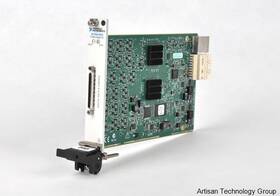
( Brand: Ni ), ( Manufacturer Part Number: PXIE-6535 ), ( Part Type: Digital ), ( Country Of Origin: United States )
Review NI Mhz Digital I/o Pxi Express
The **NI PXIe-6535** is a high-performance, modular digital I/O (input/output) device designed for demanding applications in test, measurement, and automation systems within the PXI platform. Engineered by National Instruments (NI), this versatile instrument combines robust signal conditioning, flexible triggering, and seamless integration with LabVIEW, NI TestStand, and other NI software ecosystems to deliver precise control and data acquisition capabilities. With a total of **10 digital I/O lines** comprising **8 configurable inputs/outputs (I/O)** and **2 auxiliary inputs** the PXIe-6535 offers a compact yet powerful solution for applications requiring high-speed digital signal manipulation, such as logic state monitoring, pulse generation, event sequencing, or interfacing with field-programmable gate arrays (FPGAs) and other digital devices. Its **100 MHz maximum update rate** ensures real-time responsiveness, making it ideal for applications where timing accuracy and throughput are critical, such as automated test systems (ATS), industrial process control, or research and development environments where rapid data acquisition and signal generation are essential.
The PXIe-6535 is built on NI s proven PXI Express (PXIe) architecture, leveraging the high-speed backplane connectivity of the PXI platform to maximize data throughput and minimize latency. Its **PXIe CompactPCI form factor** allows for easy integration into existing PXI systems, while its **low power consumption** (approximately 10W) ensures efficient operation in resource-constrained environments. The device features **configurable I/O lines** that can be individually programmed as inputs, outputs, or bidirectional signals, providing unparalleled flexibility for custom test setups. Additionally, the **2 auxiliary inputs** can be used for additional triggering, timing, or status monitoring, further enhancing its utility in complex system designs. The PXIe-6535 supports **NI-Digital** and **NI-VISA** drivers, enabling seamless communication with NI s software tools, while its compatibility with **LabVIEW FPGA** allows for the implementation of custom FPGA-based logic directly on the device, reducing latency and improving overall system performance.
Beyond its technical specifications, the PXIe-6535 is designed with reliability and ease of use in mind. Its **ruggedized construction** ensures durability in demanding environments, while its **plug-and-play compatibility** with NI s software suite minimizes development time. The device also includes **built-in diagnostics and error handling**, providing real-time feedback to troubleshoot issues and maintain system integrity. Whether used for **logic analyzer applications**, where it captures and analyzes digital signals at high speeds, or for **arbitrary waveform generation**, where it controls external devices with precise timing, the PXIe-6535 serves as a versatile building block for a wide range of automated testing and control systems. Its integration with NI s broader ecosystem of hardware and software tools further amplifies its capabilities, making it an indispensable component for engineers and scientists seeking a reliable, high-performance digital I/O solution.
### Pros and Cons of buying a NI PXIe-6535 10-Digit Digital I/O for PXI
#### **Pros**
1. **High-Speed Data Acquisition and Generation**
The NI PXIe-6535 is designed for high-speed digital I/O operations, capable of handling up to 10 digits of parallel data with a maximum timing resolution of 100 ps. This makes it suitable for applications requiring precise timing, such as automated test equipment (ATE), industrial automation, and signal generation.
2. **Integration with NI Platform**
As part of the National Instruments (NI) ecosystem, the PXIe-6535 seamlessly integrates with LabVIEW, LabWindows/CVI, and other NI software tools. This simplifies development, debugging, and deployment of complex control and measurement systems. Users familiar with NI tools will find it easier to implement and optimize their applications.
3. **Compact and Modular Design**
The PXI standard ensures a compact, standardized form factor that fits into a PXI chassis, saving space in test systems or control cabinets. The modular nature allows for easy expansion by adding other PXI modules for additional functionality (e.g., analog I/O, RF, or timing triggers).
4. **High Reliability and Durability**
NI PXI modules are built for rugged environments, with features like fanless operation (in some configurations), low power consumption, and robust mechanical design. This makes the PXIe-6535 suitable for field-deployed or industrial applications where reliability is critical.
5. **Flexible Triggering and Synchronization**
The module supports advanced triggering capabilities, including software, hardware, and bus triggers, which are essential for coordinating operations across multiple instruments or modules. This is particularly useful in multi-channel or distributed measurement systems.
6. **Support for Advanced Digital Patterns**
With 10 digits of parallel I/O, the PXIe-6535 can generate or read complex digital patterns, such as serial data streams, bus protocols (e.g., SPI, I2C, CAN), or custom bit patterns. This is valuable for testing digital interfaces, microcontrollers, or communication protocols.
7. **Software-Defined Functionality**
The module s capabilities are largely defined by software, allowing users to reconfigure its behavior without hardware changes. This flexibility is ideal for research and development or applications where requirements may evolve over time.
8. **Commercial Support and Documentation**
NI provides extensive documentation, tutorials, and technical support for its products. This reduces the learning curve for new users and ensures that troubleshooting and maintenance are straightforward.
9. **Scalability**
The PXIe-6535 can be paired with other NI modules (e.g., PXIe-6571 for 16-digit I/O, PXIe-6561 for 8-digit I/O) to meet higher throughput or more complex requirements. This scalability ensures that the system can grow with your needs.
10. **Industry Standard Compatibility**
The PXI standard is widely adopted in industries like aerospace, defense, automotive, and semiconductor testing. This means that the PXIe-6535 is likely to be compatible with existing test systems or standards in your field.
---
#### **Cons**
1. **High Cost**
The PXIe-6535 is a high-end digital I/O module, and its price reflects its advanced features and NI s brand. For applications with simpler or lower-speed digital I/O requirements, alternative solutions (e.g., USB-based or PCIe modules) may offer comparable performance at a lower cost.
2. **Complexity for Beginners**
While the NI ecosystem is powerful, it can be overwhelming for users new to LabVIEW or PXI systems. The learning curve for developing applications with this module may require additional training or resources, especially for those unfamiliar with NI software.
3. **Dependence on NI Software**
The full functionality of the PXIe-6535 is unlocked through NI s software suite, which can be expensive to license. Users who prefer open-source or third-party tools may find themselves limited in terms of software compatibility or flexibility.
4. **Limited Parallel Ports**
With only 10 digits of parallel I/O, the PXIe-6535 may not be sufficient for applications requiring high parallelism (e.g., testing multiple devices simultaneously). In such cases, users might need to combine multiple modules or use a higher-digit module (e.g., PXIe-6571).
5. **Power and Space Requirements**
While PXI modules are compact, they still require a PXI chassis, which adds to the overall system footprint and power consumption. For space-constrained or battery-powered applications, this could be a limiting factor.
6. **Potential Latency in Software-Defined Operations**
Although the timing resolution is excellent (100 ps), software-defined operations (e.g., complex pattern generation) may introduce slight latency compared to purely hardware-based solutions. For ultra-low-latency applications, this could be a consideration.
7. **Vendor Lock-In**
NI s proprietary software and hardware ecosystem can create vendor lock-in, making it difficult to migrate to alternative platforms if needed. This could be a concern for long-term projects or those requiring interoperability with non-NI systems.
8. **Maintenance and Upgrades**
While NI provides support, upgrading firmware or replacing modules may require purchasing new hardware or software licenses. This can add to the long-term cost of ownership, especially if the system is used for critical applications.
9. **Limited Analog I/O Capabilities**
The PXIe-6535 is primarily a digital I/O module and lacks built-in analog I/O functionality. Applications requiring both digital and analog signals may need to pair it with additional modules (e.g., PXIe-6363 for analog I/O), increasing complexity and cost.
10. **Potential for Overkill**
For applications with modest digital I/O requirements, the PXIe-6535 may offer more features than necessary. In such cases, simpler or lower-cost alternatives (e.g., USB-based digital I/O cards) could suffice without the added complexity.
---
### **Conclusion**
The NI PXIe-6535 10-Digit Digital I/O for PXI is a high-performance module well-suited for applications demanding precise timing, high-speed digital operations, and integration with the NI ecosystem. Its strengths lie in its speed, flexibility, reliability, and compatibility with advanced software tools like LabVIEW. However, its high cost, complexity for beginners, and dependence on NI software may pose challenges for some users.
For users working in industries like aerospace, defense, semiconductor testing, or industrial automation where precision, scalability, and integration with existing NI systems are critical the PXIe-6535 is an excellent choice. It excels in environments where high-speed digital I/O, advanced triggering, and software-defined functionality are priorities.
For applications with simpler requirements, lower budgets, or a preference for open-source or non-NI tools, alternative solutions (e.g., USB-based digital I/O cards, PCIe modules, or FPGA-based systems) may be more appropriate. Additionally, if the primary need is analog I/O alongside digital, pairing the PXIe-6535 with complementary modules could be necessary, adding to the system s complexity and cost.
---
### **Recommendation**
**Buy the NI PXIe-6535 if:**- You are working in a field (e.g., aerospace, defense, semiconductor testing) where high-speed digital I/O, precise timing, and integration with NI tools are essential.
- Your application requires advanced triggering, parallel digital operations, or complex pattern generation.
- You already have a PXI chassis and are part of an NI ecosystem, benefiting from existing software licenses and infrastructure.
- You prioritize reliability, scalability, and long-term support over cost.
**Avoid or Consider Alternatives if:**- Your budget is limited, and simpler digital I/O solutions (e.g., USB-based cards) can meet your needs.
- You are new to NI software and lack the resources to learn LabVIEW or other NI tools.
- Your application does not require the full 10-digit parallel I/O capacity, and a lower-cost module would suffice.
- You prefer open-source or third-party software and want to avoid vendor lock-in.
- Your system primarily requires analog I/O alongside digital, and you are willing to pair the PXIe-6535 with additional modules.
In summary, the PXIe-6535 is a powerful tool for specialized applications but may not be the most cost-effective or accessible choice for all users. Carefully evaluate your specific requirements before purchasing.
Details:
Fast and hassle-free. Are not included with this equipment unless pictured and/or listed in the above. The products Artisan Technology Group offers is used surplus. This lifting is not approved or sanctioned by any manufacturer trade name listed.
NI PXIe-6535 10 Mhz Digital I/O for PXI Express.
part #: pxie6535 prices
- $995.00-$2150.00
specifications sensoindustria:
- brand: Ni
- mpn: Pxie-6535
- part type: Digital
- country of origin: United States
offer sensoindustria:
- sold: 0
- started: April 15, 2026
- options: Ship-to-home
- quantity: 3
- availability: In Stock
general sensoindustria:
- PLCs HMIs > PLC Peripheral Modules > PLC Input Output Modules
- condition: Used
seller sensoindustria:
- # reviews: 17706
- rating: 99.9%
- city: Champaign, Illinois
payments sensoindustria:
- wallet: Apple-pay
- credit card: Mastercard
- other
shipping sensoindustria:
- cost: $25.01
- class: Standard, One-day, Economy
- transit: 3-8 Days
- service: FedEx Ground / FedEx Home Delivery, FedEx Standard OverNight, FedEx Ground Economy
- carrier: FedEx
- type: Calculated
returns sensoindustria:
- paid by: Buyer
- policy: Returns Accepted
- method: Money back
- time: 30 Days
Ni PXIE-6535 Is Similar To:
- 194918a National Instruments Ni Pxi-1033 (20.7% similar) National instruments Ni PXI-1033 pxi chassis 194918A...(May 22nd, 2017)
- Ni 9264 National Instruments Series Digital Module (33% similar) Minimal wear use. I have sold many online with no issues. National instruments NI-9435 c series digital module CDC to 10 vac 250 vac, 4-CHANNEL sinking sourcing input, 3 ms the Ni works with industrial logic levels and signals connect directly a wide array of switches, transducers, devices. Each ...(August 6th, 2018)
- Ni-9421 National Instruments Digital Input Module (35.4% similar) Each channel is compatible with 24 v logic levels and has an led indicating the state of that. The Ni offers isolation between input channels and earth ground. Was purchased for a project which never commissioned. In full working condition. Please see my other listings for a CRIO-9025 real-time ...(May 5th, 2018)
- Ni Crio 9423 National Instruments Quanser Series Module For Compactrio (32.5% similar) SPECS-1 configurable analog output v, 5/1 0. This listing is for a national instruments Q1-CRIO - quines c series module Ni compactor, has been lightly used, but in excellent condition and tested good. 8 v output RANGES1 configurable analog input 5 v, 10 RANGES16-BIT resolution for and OUTPUT2 to 24...(October 24th, 2018)
- National Instruments Ni-9422 8-channel Digital Input Module Used (32.4% similar) National instruments NI-9422 8-CHANNEL digital input module used. Industries. Our delivery methods include speedups, DHL, ups, USPS, etc. Item specifics: brand: national instruments, mpn: NI-9422...(April 19th, 2024)
- Ni Pxi-6542 1pc Used National Instruments 778953-02 100mhz Digital I o (46.2% similar) Serious buyers only, please. The product at fixed price, please pay as soon possible after the purchase. You should receive the item within 2-4 weeks. Return police: please leave a telephone number for on-time delivery. It will just take you 1 minute. Shipping detail...(August 19th, 2024)
- National Instruments Ni-9403 Ni 9403 With Dsub 32-ch Ttl Digital Input Output Module (27.1% similar) Guaranteed to work...(August 22nd, 2024)
- National Instruments Ni-9425 Cdaq Digital Input Module 24v 32ch Free Shipping (32.3% similar) Dear customer, there is one things need to be noticed before placing an order. Operating various types of industrial products, mechanical modules. 25B-D2P3N104. 25B-D6P0N104. 25B-D1P4N104. 22B-D010N104...(August 27th, 2024)
- National Instruments Pxi-6025e Ni Multifunction I o Module (36.2% similar) Solenoid coils. Model: Ni PXI-6025E. Solenoid valves. Knife gate valves. Pneumatic exhaust valves. Shock absorbs...(October 6th, 2024)
- National Instruments Crio-9474 Ni 8-ch 24v High-speed Sourcing Digital Output (24.2% similar) National instruments Ni CRIO-9474 8-CH 24V high-speed sourcing digital output...(October 18th, 2024)
- Ni 778512-01 1pc Used Pxi-6733 Data Acquisition Card High Speed Analog Output (25.8% similar) Return police: the product at fixed price, please pay as soon possible after the purchase. Shipping detail. Serious buyers only, please. You should receive the item within 2-4 weeks. Please leave a telephone number for on-time delivery. It will just take you 1 minute...(January 2nd, 2025)
