OKUMA PC13902 Howa Relay Terminal Module Pcb Board PC6 XTB1
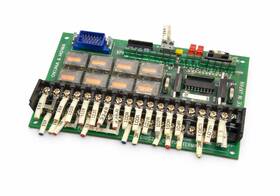
( Brand: Okuma ), ( Manufacturer Part Number: PC13902 ), ( Type: Relay Terminal Module ), ( Country Of Origin: Japan )
Review OKUMA And Howa Pc6 Relay Terminal Module Pcb Board Tested Working
The **Okuma PC13902 Howa PC6 Relay Terminal Module PCB Board (XTB1)** is a high-performance, industrial-grade relay control module designed for seamless integration into CNC machining centers, automated manufacturing systems, and precision control applications. Engineered for reliability and precision, this terminal module serves as a critical interface between the machine s control system and external devices, enabling efficient signal routing, power distribution, and relay actuation. Built with a robust **XTB1** terminal block design, it features a compact yet durable PCB layout optimized for high-density wiring, ensuring clean and secure connections while minimizing signal interference. The module accommodates a variety of **Howa PC6 relays**, which are renowned for their low contact resistance, extended operational lifespan, and resistance to electrical noise, making them ideal for demanding industrial environments where reliability is paramount.
This relay terminal module is specifically tailored for Okuma s **PC13902** control series, offering seamless compatibility with the machine s control architecture while providing flexibility in customizing relay configurations to match specific application requirements. The PCB board incorporates a **high-current capacity** design, allowing for the safe handling of multiple relays in parallel, which is essential for controlling high-power actuators, spindle motors, coolant systems, or tool changers in CNC operations. Each relay terminal is meticulously labeled and organized, facilitating quick identification and troubleshooting, while the modular construction ensures easy installation and replacement without disrupting the entire system.
Beyond its functional robustness, the **XTB1 terminal module** is engineered with **electromagnetic compatibility (EMC) standards** in mind, ensuring minimal interference with sensitive control signals and reducing the risk of malfunctions in noisy industrial settings. The use of **high-quality soldering and insulation materials** further enhances durability, protecting against thermal stress, vibration, and environmental contaminants that could compromise performance over time. Whether deployed in a high-speed milling application, a multi-axis lathe, or an automated assembly line, this relay terminal module delivers consistent performance, precise control, and long-term reliability making it an indispensable component for operators seeking to optimize efficiency and reduce downtime in their machining processes.
### **Pros and Cons of buying a Okuma PC13902 (HOWA PC6 Relay Terminal Module PCB Board XTB1)**
#### **Overview**
The **Okuma PC13902** (compatible with HOWA PC6) is a **relay terminal module** designed for industrial control systems, particularly in CNC machines, automation, and PLC applications. It serves as an interface between control signals and external devices like relays, sensors, or actuators. Below is a detailed analysis of its advantages and drawbacks.
---
### **Pros**
1. **Compatibility with Okuma/HOWA CNC Systems**
- The module is specifically designed to integrate seamlessly with **Okuma CNC machines** (e.g., Okuma L-series, Multi Tasking machines) and **HOWA PC6 controllers**, reducing the need for custom modifications.
- Works as a **terminal block and relay driver** in one unit, simplifying wiring and reducing space requirements.
2. **High Reliability and Durability**
- Built for **industrial environments**, it is designed to withstand **vibration, temperature fluctuations, and electrical noise** common in manufacturing settings.
- Uses **high-quality relays** (likely **solid-state or mechanical relays**) with adequate contact ratings for frequent switching applications.
3. **Modular and Expandable Design**
- The **XTB1** (terminal block) allows for **easy connection and disconnection** of wires, reducing downtime for maintenance or rewiring.
- Can be **stacked or combined with other Okuma/HOWA modules** (e.g., power supplies, I/O expanders) for larger control systems.
4. **Reduced Wiring Complexity**
- Consolidates **multiple relay outputs and terminal connections** into a single module, minimizing **cable clutter** and **connection points**, which reduces the risk of loose wires or shorts.
- Some versions may include **fuse protection**, improving overall system safety.
5. **Backward and Forward Compatibility**
- Designed to work with **older Okuma/HOWA systems** while also supporting **newer firmware updates** if available.
- Replaces older relay modules, ensuring **consistent performance** in upgraded systems.
6. **Support for High-Current Applications**
- Capable of driving **relays with sufficient contact ratings** (typically **10A 20A per channel**, depending on the exact model), making it suitable for **motor starters, solenoids, and high-power actuators**.
- Some variants may include **optical isolation** for better noise immunity.
7. **Ease of Installation and Troubleshooting**
- **Plug-and-play compatibility** with Okuma/HOWA controllers means minimal configuration is required.
- **Clear labeling** on terminals helps with quick identification during wiring or diagnostics.
8. **Cost-Effective for Bulk Applications**
- While not the **cheapest** relay module on the market, it offers **long-term reliability**, reducing the need for frequent replacements.
- Purchasing in **bulk** (if available) can lower per-unit costs.
9. **Support from Okuma/HOWA Technical Teams**
- Since it is an **official or authorized module**, users can rely on **manufacturer support** for troubleshooting, firmware updates, or replacements.
- Documentation and **technical manuals** are typically well-documented.
10. **Space Efficiency**
- Compact design allows for **better utilization of control panel space**, which is critical in **smaller CNC machines or automated cells**.
---
### **Cons**
1. **Limited Availability and Lead Times**
- As an **industrial component**, it may not be as widely stocked as generic relay modules (e.g., from Omron, Siemens, or Allen-Bradley).
- **Longer delivery times** compared to mass-market electronics, which can delay projects.
- May require **purchasing through authorized Okuma/HOWA distributors**, increasing costs.
2. **Higher Cost Compared to Generic Alternatives**
- More expensive than **off-the-shelf relay modules** from brands like **Siemens, Omron, or TE Connectivity**.
- If the module fails, **replacement costs** may be higher than generic equivalents.
3. **Vendor Lock-In Risks**
- Designed **exclusively for Okuma/HOWA systems**, meaning **limited compatibility** with other CNC brands (e.g., Mazak, Fanuc, Mitsubishi).
- If switching to a different controller, the module may **not be usable**, requiring a full replacement.
4. **Potential for Obsolescence**
- Okuma and HOWA occasionally **discontinue older models**, leading to **hard-to-find parts** over time.
- If the **PC6 controller is phased out**, future support may diminish.
5. **Firmware and Software Dependencies**
- Performance may be **tied to specific CNC firmware versions**; incompatible updates could cause **malfunctions**.
- Requires **proper programming** in the Okuma/HOWA control software to function correctly.
6. **Mechanical Relay Limitations**
- If the module uses **mechanical relays**, they may have **limited lifespan** (typically **10 50 million cycles**) compared to **solid-state relays**, which can last much longer.
- **Contact bounce** in mechanical relays may require **debouncing circuits** in some applications.
7. **No Built-In Diagnostics (In Some Cases)**
- Unlike some **smart relay modules**, this may not have **self-diagnostic features** (e.g., LED status indicators for each relay).
- Fault detection may rely on **external monitoring** or **controller error logs**.
8. **Potential for Counterfeit or Low-Quality Replacements**
- Since it is a **specialized component**, there is a risk of **fake or refurbished units** entering the market, which may **fail prematurely**.
- Always **verify authenticity** from **authorized sellers**.
9. **Limited Customization Options**
- Unlike **generic I/O modules**, this module has **fixed relay counts and configurations**, making it **less flexible** for non-standard applications.
- Cannot be **reprogrammed or reconfigured** like some PLC-compatible modules.
10. **Requires Technical Knowledge for Installation**
- Not a **plug-and-play** solution for **non-experts**; improper wiring or power connections can **damage the module or connected devices**.
- Best installed by **certified CNC technicians or electricians**.
---
### **Conclusion**
The **Okuma PC13902 (HOWA PC6 Relay Terminal Module)** is a **highly specialized, reliable, and well-integrated** component for **Okuma/HOWA CNC systems**. It excels in **industrial durability, ease of integration, and compatibility** with its native controllers, making it an **excellent choice for users already invested in the Okuma/HOWA ecosystem**.
However, its **higher cost, limited availability, and vendor lock-in risks** make it **less ideal** for **general-purpose automation** or **non-Okuma/HOWA systems**. If you are **working within an Okuma/HOWA environment and need a robust, long-term relay solution**, this module is a **strong recommendation**. For **cost-sensitive or flexible applications**, a **generic relay module** (e.g., from Siemens or Omron) may be a better alternative.
---
### **Recommendation**
#### **Buy If:**You are **maintaining or upgrading an Okuma/HOWA CNC machine** and need a **reliable relay terminal module**.
You prioritize **long-term compatibility and support** from Okuma/HOWA.
Your application requires **high-current relay driving** with **industrial-grade durability**.
You have **limited space** and need a **compact, modular solution**.
You are **willing to pay a premium** for **brand-specific reliability**.
#### **Avoid If:**You are **not using an Okuma/HOWA system** and need a **generic relay module**.
You require **extensive customization or future-proofing** beyond Okuma/HOWA.
**Budget is a major constraint**, and you can find **equally reliable generic alternatives** at a lower cost.
You need **frequent replacements** due to **limited availability** of the module.
Your application involves **high-frequency switching** where **solid-state relays** would be more suitable.
#### **Alternatives to Consider:**- **Siemens LOGO! Relay Module** (for general automation, more affordable).
- **Omron G2R Series** (high reliability, widely available).
- **TE Connectivity (AMP) Relay Terminal Blocks** (for modular, high-density applications).
- **Fanuc/Other CNC-Specific Modules** (if switching to a different brand).
#### **Final Verdict:**For **Okuma/HOWA users**, the **PC13902 is a solid, well-supported choice** that balances **reliability, integration, and durability**. For **other applications**, a **generic relay module** may offer better **flexibility and cost efficiency**. Always **verify authenticity** and **check compatibility** with your specific CNC model before purchasing.
Details:
OKUMA HOWA PC6 PC13902 Relay Terminal Module PCB Board XTB1. Designed for reliable signal distribution and control within machine automation environments. Shipping, Carefully packaged to ensure safe delivery. No further testing performed.
Made in Japan. Marked XTB1 on board. Applications, Commonly used in Okuma CNC machinery and industrial automation systems requiring relay interface terminal distribution. Part Number: PC13902.
Type: Relay Terminal Module PCB. Condition, Used condition. Shows normal signs of use such as light surface wear. Brand: Okuma Howa.
Pulled from working equipment. Overview, Industrial relay terminal module used in Okuma Howa CNC systems.
part #: pc13902 prices
- $198.00-$199.99
specifications sensoindustria:
- brand: Okuma
- mpn: Pc13902
- type: Relay Terminal Module
- country of origin: Japan
offer sensoindustria:
- sold: 0
- best offers: True
- options: Ship-to-home
- started: April 17, 2026
- quantity: 1
- availability: In Stock
returns sensoindustria:
- time: 30 Days
- paid by: Buyer
- method: Money back
- policy: Returns Accepted
shipping sensoindustria:
- transit: 5-12 Days
- carrier: USPS
- cost: $0.00
- type: Fixed
- class: Expedited
- service: USPS Priority Mail
seller sensoindustria:
- rating: 100.0%
- city: Niagara Falls, New York
- # reviews: 186
general sensoindustria:
- condition: Used
- PLCs HMIs > PLC Peripheral Modules > PLC Input Output Modules
payments sensoindustria:
- credit card: Mastercard
- wallet: Apple-pay
- other
Okuma PC13902 Is Similar To:
- E4809-578-008 Okuma Input Module D16-503-104-00 (26.4% similar) Unit name:okuma input module E4809 D16 E100 new...(September 17th, 2017)
- Okuma Dn-oc-16pc Output Module 4-port A911-oc-16pc Dnoc16pc A911oc16pc (30.3% similar) If I have a quantity of items, may use generic picture for them all. I will only do this if all of the items are same quality. Buyers are encouraged to test the purchased item thoroughly before use. I cannot be held accountable for any damages caused to equipment reason...(September 26th, 2024)
- Okuma A9113051 Dn-ic-16c A911-3051 Plc Input Module (34.6% similar) Nice take outs from closed line. 30 day guarantee...(October 1st, 2024)
- Okuma E0241-653-029-e Board See Pics 30 Day Warranty (35.8% similar) With a 30-DAY warranty, you can trust that this board is built to last and will provide reliable performance for years come. Sold as shown 120824G6. This Okuma E0241-653-029-E board is a high-quality industrial automation device that perfect for plc peripheral modules, input and output other ...(December 9th, 2024)
- Okuma E0241-653-077 Transistor High Output Module (30.5% similar) Appearance: good,:: Okuma E0241-653-077 transistor high output module. Manufacturer: Okuma: model: E0241-653-077: condition: used, pulled from a running CBC mill. Thanks for looking...(December 22nd, 2024)
- Okuma D14-503-001 02 And Howa Input Module 200-240v Warranty Fast Nda Shipping (45% similar) Okuma howa D14-503-001/02 input module 200-240V very nice clean working. Ready to install...(March 7th, 2025)
- Okuma Dn-oc-16pc2 Output Module 2a Out Used (42.5% similar) These services include: ups 3 day select. Prices for these options may differ from standard ground shipping. The cost of combined shipping depends on weight, location buyer and size box. Okuma DN-OC-16PC2 output module, 2a out. Ups next day am. Item is sold as pictured. Ups 2 day air am...(June 5th, 2025)
- Yoshida Pswr-50v8 lb35 Input Output Module Okuma Lu-15 Lathe (21.1% similar) Country of manufacture japan. Model PSWR-50V8/LB35. Part NUMBERPSWR-50V8/LB35. And the cost of return shipping. Condition used. Ask our experts. Comes off of an Okuma LU-15 lathe. Items in LOT1. Removed from a working environment...(June 23rd, 2025)
- Okuma Howa Pc17702a Pc17702 I o Relay Board 30 Day Warranty (43.7% similar) Missing some of the plastic mounts and terminal covers. Taken out of a running machine. Some of the relays have been replaced with more modern ones...(October 13th, 2025)
- Okuma A911-3053 Used Output Module (27.6% similar) Used Okuma A911-3053 output module, - shelf A14 tote 286...(March 24th, 2026)
