EATON CUTLER-HAMMER D77D-DNA Plc Module Devicenet Adapter I/o RS232
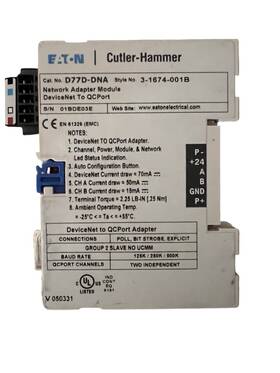
( Brand: Eaton Cutler-hammer ), ( Manufacturer Part Number: D77D-DNA ), ( Type: Plc Input/output Module ), ( Communication Standard: Devicenet, Rs232 ), ( Country Of Origin: United States )
Review EATON CUTLER HAMMER Plc I/o Module Devicenet Rs232 Adapter Tested
The **Eaton Cutler-Hammer D77D-DNA PLC I/O Module DeviceNet RS232 Adapter** is a robust and versatile communication interface designed to bridge the gap between industrial automation systems and legacy or non-native protocols. This high-performance adapter module is engineered to seamlessly integrate with the **D77D series programmable logic controllers (PLCs)**, enabling seamless data exchange over **DeviceNet** while providing an optional **RS232 serial interface** for additional connectivity flexibility. Built to withstand the demanding environments of manufacturing, process control, and industrial automation, the adapter is constructed with rugged, industrial-grade materials that ensure reliability, durability, and long-term performance in harsh conditions, including temperature fluctuations, vibration, and electrical noise.
The **DeviceNet** interface adheres to the **Common Industrial Protocol (CIP)**, a widely adopted standard in industrial automation, allowing for efficient, real-time communication between PLCs, sensors, actuators, and other field devices. This protocol supports deterministic data transfer, ensuring minimal latency and consistent performance critical for applications requiring precise synchronization, such as motion control, discrete manufacturing, or process monitoring. The adapter s **DeviceNet port** is equipped with a **17-pin D-sub connector**, providing a secure and standardized connection for direct integration into DeviceNet networks, while its **RS232 interface** (optional, depending on configuration) offers an additional layer of compatibility, enabling communication with legacy systems, test equipment, or other serial devices that may not support DeviceNet.
At its core, the **D77D-DNA** module is designed to enhance the functionality of the Cutler-Hammer D77D PLC by expanding its I/O capabilities and communication options. The adapter supports **point-to-point or multi-drop DeviceNet configurations**, allowing it to function as either a master or slave device within the network, depending on the application requirements. This modular flexibility ensures that engineers can tailor the system to specific operational needs, whether deploying it in a small-scale automation setup or a large-scale distributed control system. The **RS232 adapter** (when included) operates at configurable baud rates, parity settings, and data bits, providing full compatibility with a wide range of serial communication standards, including those used in **SCADA systems, HMI interfaces, or diagnostic tools**.
One of the standout features of this adapter is its **plug-and-play compatibility** with the D77D PLC series, eliminating the need for complex reconfiguration or additional programming. The module is pre-configured to work seamlessly with the host PLC, reducing setup time and minimizing potential errors during installation. Additionally, the adapter supports **firmware updates and protocol versioning**, ensuring compatibility with evolving industrial standards and allowing users to future-proof their automation systems. The **DeviceNet interface** also includes built-in diagnostics and error reporting, providing real-time feedback on network status, device health, and communication integrity, which is invaluable for troubleshooting and maintaining optimal system performance.
From a technical standpoint, the **D77D-DNA** module is designed with **high-speed data processing** in mind, supporting **fast cyclic scanning** and **event-driven communication** to meet the demands of real-time control applications. The **RS232 interface** (if enabled) further extends its utility by enabling asynchronous data transfer, making it suitable for applications requiring non-deterministic communication, such as logging, configuration updates, or remote monitoring. The adapter s **low-power consumption** and **efficient power management** ensure minimal impact on the PLC s overall energy usage, while its **compact and modular design** allows for easy integration into existing control panels or enclosures without sacrificing functionality.
Whether deployed in **discrete manufacturing, packaging, material handling, or process automation**, the **Eaton Cutler-Hammer D77D-DNA PLC I/O Module DeviceNet RS232 Adapter** serves as a critical link between modern industrial networks and legacy or specialized devices. Its **rugged construction, versatile communication options, and seamless integration** with the D77D PLC series make it an indispensable tool for engineers and technicians seeking to enhance system reliability, scalability, and performance. By providing a bridge between **DeviceNet s deterministic communication** and the flexibility of **RS232 serial connectivity**, this adapter ensures that industrial automation systems remain adaptable, efficient, and future-ready in an ever-evolving technological landscape.
The Eaton Cutler-Hammer D77D-DNA PLC I/O module with a DeviceNet/RS232 adapter is a specialized industrial communication module designed for integration with programmable logic controllers (PLCs). Below is a detailed analysis of its pros and cons, followed by a conclusion and recommendation.
---
### **Pros**
1. **Compatibility with Legacy Systems**
The D77D-DNA module is designed to interface with older Cutler-Hammer (now Eaton) PLCs, particularly those using the DNA (Distributed Network Architecture) protocol. This makes it useful for maintaining or upgrading existing industrial automation setups where newer PLCs may not be feasible or cost-effective.
2. **DeviceNet Support**
DeviceNet is a widely used fieldbus protocol in industrial automation, known for its robustness and reliability in harsh environments. The adapter allows for seamless communication between the PLC and DeviceNet devices (e.g., sensors, actuators, or other I/O modules), reducing the need for additional gateways or converters.
3. **RS232 Serial Communication**
The inclusion of an RS232 adapter provides a flexible communication interface for legacy devices or systems that rely on serial communication. This can be particularly useful for troubleshooting, data logging, or integrating with non-DeviceNet equipment.
4. **Modular and Expandable**
The module can be integrated into a larger I/O system, allowing for modular expansion of the PLC s input/output capabilities. This is beneficial for systems requiring additional analog or digital I/O without replacing the entire PLC.
5. **Proven Reliability**
Eaton (formerly Cutler-Hammer) has a long history in industrial automation, and its products are generally known for durability and reliability in industrial environments. The D77D-DNA module is no exception, with a reputation for stable performance in factory settings.
6. **Cost-Effective for Maintenance**
For facilities still using older Cutler-Hammer PLCs, purchasing this module can be more economical than investing in a complete system upgrade. It extends the lifespan of existing hardware while providing the necessary functionality.
7. **Technical Support and Documentation**
Eaton provides technical support and documentation for its products, which can be invaluable for troubleshooting, programming, or integration with other systems. This is particularly important for less common or older modules.
---
### **Cons**
1. **Limited Modern Compatibility**
The D77D-DNA module is designed for legacy Cutler-Hammer PLCs and may not be compatible with newer PLC platforms from Eaton or other manufacturers (e.g., Allen-Bradley, Siemens, or Schneider Electric). This can limit its usefulness in modern or mixed-environment systems.
2. **Obsolete Technology**
The DNA protocol and RS232 communication are older standards compared to modern protocols like Ethernet/IP, PROFINET, or Modbus TCP. This can introduce compatibility issues with newer devices or software tools that prioritize these more advanced protocols.
3. **Hardware Availability Challenges**
As industrial automation evolves, older modules like the D77D-DNA may become harder to source, especially if Eaton discontinues production. This could lead to supply chain issues or higher costs if the module needs to be replaced in the future.
4. **Programming and Configuration Complexity**
Configuring the D77D-DNA module may require familiarity with older programming environments or DNA protocol specifics. Engineers or technicians unfamiliar with these systems may face a steep learning curve or require additional training.
5. **Limited Scalability**
While the module can expand I/O capabilities, its scalability is limited by the PLC s architecture. For large or complex systems, a more modern PLC with Ethernet-based communication may be a better long-term solution.
6. **Potential for Higher Maintenance Costs**
Since the module is designed for older systems, spare parts, firmware updates, or technical support may be less readily available compared to newer Eaton products. This could increase maintenance overhead over time.
7. **Security Risks**
Older communication protocols like RS232 and DeviceNet lack the security features of modern industrial protocols (e.g., encryption, authentication, or network segmentation). This makes the system more vulnerable to cybersecurity threats, which is increasingly critical in modern industrial environments.
---
### **Conclusion**
The Eaton Cutler-Hammer D77D-DNA PLC I/O module with DeviceNet/RS232 adapter is a practical choice for facilities that rely on legacy Cutler-Hammer PLCs and need to maintain or expand their I/O capabilities without a full system overhaul. Its strengths lie in compatibility with older systems, reliability, and cost-effectiveness for short-term or maintenance-focused applications. However, its limitations such as obsolescence, limited modern compatibility, and potential scalability issues make it less ideal for new installations or systems requiring advanced communication protocols.
For facilities planning long-term growth or modernization, investing in a newer PLC with Ethernet-based communication (e.g., Ethernet/IP, PROFINET) and modern I/O modules would be a more future-proof solution. However, if the system is already in place and the module meets the immediate needs without significant disruption, it remains a viable option.
---
### **Recommendation**
- **Buy the D77D-DNA module if:**- Your facility is still using legacy Cutler-Hammer PLCs and requires additional I/O or communication flexibility.
- You need a cost-effective solution for maintaining or upgrading an existing system without replacing the entire PLC.
- DeviceNet or RS232 compatibility is non-negotiable for your current setup, and you have access to technical support or documentation.
- **Avoid or defer purchase if:**- You are planning a full system upgrade or modernization in the near future, as newer PLCs and I/O modules will offer better compatibility and scalability.
- Your system requires advanced communication protocols (e.g., Ethernet/IP, Modbus TCP) or cybersecurity features that older modules cannot provide.
- You anticipate difficulty sourcing spare parts or technical support for the module in the long term.
For most new projects or facilities with modern requirements, prioritize PLCs and I/O modules that support current industrial standards. However, for legacy systems where the D77D-DNA module is the only viable option, it remains a functional and reliable choice. Always ensure you have a backup plan for parts or support to mitigate risks associated with obsolescence.
Details:
This specific module is designed by Eaton Cutler-Hammer, a trusted brand in industrial automation. The model, D77D-DNA, ensures compatibility and functionality for efficient control system operations. Its use in PLC peripherals and motion control systems makes it a valuable dependable tool for industrial automation applications. Eaton Cutler-Hammer D77D-DNA PLC I/O Module is a reliable and tested device that allows for communication between PCs various devices using DeviceNet RS232 standards.
part #: d77d-dna prices
- $1350.00-$2500.00
specifications sensoindustria:
- brand: Eaton Cutler-hammer
- mpn: D77d-dna
- type: Plc Input/output Module
- communication standard: Devicenet, Rs232
- country of origin: United States
general sensoindustria:
- condition: Used
- PLCs HMIs > PLC Peripheral Modules > PLC Input Output Modules
payments sensoindustria:
- credit card: Mastercard
- wallet: Apple-pay
- other
seller sensoindustria:
- rating: 0.0%
- city: Lexington, North Carolina
- # reviews: 101
shipping sensoindustria:
- carrier: USPS
- cost: $8.72
- transit: 5-11 Days
- class: Standard
- type: Calculated
- service: USPS Ground Advantage
returns sensoindustria:
- policy: No Returns
offer sensoindustria:
- availability: In Stock
- sold: 0
- options: Ship-to-home
- started: April 17, 2026
- best offers: True
- quantity: 3
Eaton Cutler-hammer D77D-DNA Is Similar To:
- 1014018 Eaton Nib Plc Relay Interface Card (27.7% similar) Nib Eaton plc, relay interface card...(August 16th, 2018)
- 115s-13-24 Eaton Elpro Serial Module (29% similar) Eaton I o module model number: 115S this Elroy serial module is guaranteed to be in great working condition...(July 8th, 2018)
- 1241d-6501 Cutler-hammer Cutler Hammer Eaton Opcon (43.5% similar) ...(February 17th, 2017)
- 1c19628g02 Eaton Nib Plc Input Module (30.4% similar) Make your best offer. Shipping will always be combined and calculated per order. Post office. Because of this, we now offer immediate responses through direct messaging. Used Nash item has been but is presumed in working condition. Arcs, asset recovery company of America arcs supply. . Item and or ...(August 30th, 2018)
- A50-cn0 Eaton Corporation Cutler Hammer (26.8% similar) Free us shipping. Eaton corporation cutler hammer A50-CN0 circuit breaker contractor. Condition: used, untested, shows signs of normal wear, selling as is for parts or repair...(September 5th, 2017)
- C440-xcom Eaton Expansion Module Dc Remote Reset New In Box (34% similar) Eaton expansion module cat: C440-XCOMNEW in box...(February 26th, 2019)
- C441l Eaton Devicenet Module (31% similar) Eaton devicenet module cat: C441L...(September 3rd, 2018)
- C441n Eaton Nib Plc Command Module (31.1% similar) Make your best offer. Post office. Because of this, we now offer immediate responses through direct messaging. Shipping will always be combined and calculated per order. These items are sold as is and purchased at buyers risk. For packages under 24OZ. Arcs, asset recovery company of America arcs ...(March 26th, 2018)
- C441q Eaton Profibus Com Module Communication Adapter New In Box (40.8% similar) Eaton profits communication module cat: C441Q24VDC...(September 3rd, 2018)
- C441s Eaton Nib Mi Profibus Comm Module Vac Io (29.9% similar) Item and or parts are presumed to work. Used Nash item has been but is presumed in working condition. Refurbished Nash certified repairs, updates, and testing to bring an item working condition. These items are sold as is and purchased at buyers risk. Because of this, we now offer immediate ...(March 26th, 2018)
- C441t Eaton Modbus Communication Adapter And Http (35% similar) Eaton Ethernet IP mod bus communication adapter cat: C441TTCP rut and with 24VDC inputs new in box...(July 28th, 2018)
