ALLEN BRADLEY PCS105PS400 Plc Modules
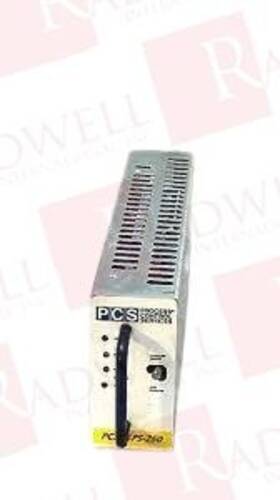
( Brand: Allen Bradley ), ( Manufacturer Part Number: PCS105PS400 ), ( Part Type: Module )
Review ALLEN BRADLEY Used
The **Allen-Bradley PLC-5/105PS400** is a robust and versatile programmable logic controller (PLC) designed by Rockwell Automation to deliver reliable automation solutions for industrial applications requiring high-performance control and scalability. Part of the legacy PLC-5 series, this model features a **105-series CPU**, which is renowned for its durability, expandability, and compatibility with a wide range of I/O modules, communication protocols, and third-party devices. The **PS400** designation indicates a **400-point I/O capacity**, allowing it to manage a substantial number of digital and analog inputs and outputs, making it ideal for medium to large-scale automation tasks such as manufacturing, process control, material handling, and discrete production lines. With a **16-bit architecture**, the PLC-5/105PS400 executes complex control logic at high speeds, ensuring precise timing and synchronization for critical operations. Its **16K words of user memory** provides ample space for storing ladder logic programs, data tables, and system configurations, while the **16K words of data memory** enables efficient handling of process variables, trends, and historical data logging. The controller operates within a **wide temperature range of -20 C to 60 C**, making it suitable for harsh industrial environments, and its **compact, ruggedized design** ensures long-term reliability in demanding applications.
One of the standout features of the PLC-5/105PS400 is its **extensive communication capabilities**, which include support for **Data Highway (DH-485)**, **Remote I/O (RIO)**, and **serial communication protocols** such as ASCII and RTU, facilitating seamless integration with supervisory control and data acquisition (SCADA) systems, human-machine interfaces (HMIs), and other PLCs or industrial networks. This flexibility allows engineers to implement distributed control architectures, enabling remote monitoring and control of processes across large facilities. The **105-series CPU** also supports **high-speed counter modules**, enabling precise motion control, pulse counting, and encoder feedback integration, which is essential for applications requiring accurate positioning or speed regulation. Additionally, the PLC-5/105PS400 is backward-compatible with a vast array of **Allen-Bradley I/O modules**, expansion units, and legacy peripherals, making it a cost-effective upgrade path for existing PLC-5 installations while still benefiting from modern automation advancements.
For applications demanding advanced functionality, the PLC-5/105PS400 can be enhanced with optional **math, trigonometric, and floating-point arithmetic modules**, as well as **specialized I/O modules** such as analog input/output (AI/O), high-speed counters, and communication modules for protocols like **Modbus** or **Ethernet/IP** (via third-party adapters). Its **deterministic control** ensures predictable performance, which is critical for applications requiring real-time responses, such as safety systems, conveyor control, or synchronized machine operations. The controller s **built-in diagnostics** and **self-monitoring capabilities** simplify troubleshooting, providing real-time error codes, status updates, and fault logging to minimize downtime. Furthermore, the PLC-5/105PS400 is supported by **Rockwell Automation s Studio 5000 software**, allowing users to develop, debug, and maintain programs using a familiar environment while leveraging modern development tools. Whether deployed in a new automation project or integrated into an existing system, the **Allen-Bradley PLC-5/105PS400** remains a dependable workhorse for industries seeking reliable, high-performance control solutions.
### **Pros and Cons of Buying an Allen-Bradley PLC-5/105PS400**
The **Allen-Bradley PLC-5/105PS400** is a legacy programmable logic controller (PLC) from Rockwell Automation, introduced in the 1990s. While it remains functional in many industrial applications, its purchase today requires careful consideration due to its age, availability, and compatibility issues.
---
### **Pros**
1. **Proven Reliability**
The PLC-5 series is known for its robustness and long operational lifespan in harsh industrial environments. Many users report minimal downtime over decades of use, especially when maintained properly.
2. **Widespread Availability of Parts**
As a legacy system, spare parts (such as power supplies, modules, and I/O) are still available from third-party suppliers, eBay, and specialized distributors. This reduces the risk of sudden obsolescence compared to newer PLCs with dwindling support.
3. **Mature Programming and Documentation**
The PLC-5 uses **Ladder Logic (LD)**, a widely understood programming language in industrial automation. Extensive documentation, manuals, and a large pool of experienced technicians familiar with the system exist. This makes troubleshooting and programming easier for those with industrial experience.
4. **Compatibility with Older Systems**
If your facility relies on legacy equipment or control systems that interface with the PLC-5, this unit may be the most straightforward choice for maintaining continuity without requiring a full system overhaul.
5. **Lower Initial Cost (Compared to New PLCs)**
Since the PLC-5 is no longer in active production, purchasing one can be significantly cheaper than buying a modern PLC (e.g., Allen-Bradley ControlLogix or CompactLogix). This can be advantageous for budget-conscious projects or small-scale applications.
6. **Backward Compatibility with RSLogix 5**
The PLC-5 is fully supported by **RSLogix 5**, a stable and well-documented programming environment. While newer Rockwell software (e.g., Studio 5000) does not natively support it, third-party tools like **PLCLogix** or **CodeSys** can emulate or interface with it.
7. **Deterministic Performance**
The PLC-5 is known for its predictable scan times, which can be critical in applications requiring strict timing (e.g., motion control, safety systems). Modern PLCs may introduce slight variability due to higher processing demands.
---
### **Cons**
1. **Lack of Active Support from Rockwell Automation**
Rockwell Automation no longer manufactures or officially supports the PLC-5 series. This means no warranty, limited technical assistance from the manufacturer, and no future firmware or software updates.
2. **Limited I/O and Expansion Capabilities**
The **PLC-5/105PS400** has a fixed number of I/O points (105 discrete I/O) and relies on external **17xx-series modules** for additional functionality. Modern PLCs offer integrated I/O, analog modules, and higher density, making them more flexible for expanding applications.
3. **Outdated Communication Protocols**
The PLC-5 primarily uses **DH-485 (Data Highway)** or **RS-232/RS-485** for communication, which are less common in modern industrial networks. Integrating it with newer SCADA systems, HMI, or Ethernet-based networks can require additional gateways or converters.
4. **Deprecated Programming Tools**
While **RSLogix 5** is still functional, it lacks modern features such as:- **Object-Oriented Programming (OOP)**
- **Advanced debugging tools**
- **Integration with cloud or IoT platforms**
- **Support for newer communication protocols (e.g., Ethernet/IP, Modbus TCP)**
This can limit the system s adaptability to evolving industrial requirements.
5. **Higher Long-Term Maintenance Costs**
Over time, finding trained technicians familiar with the PLC-5 may become difficult, as younger engineers often focus on newer technologies. This can increase training costs and reliance on legacy experts.
6. **Security Vulnerabilities**
Legacy systems like the PLC-5 were not designed with modern cybersecurity in mind. They lack built-in encryption, firewall capabilities, or support for secure communication protocols, making them more susceptible to cyber threats.
7. **Limited Analog and High-Speed I/O**
The PLC-5 s analog capabilities are basic compared to modern PLCs, which often include high-resolution AD/DA converters, pulse-width modulation (PWM), and high-speed counter modules. This can be a limitation for applications requiring precise analog control or high-speed data acquisition.
8. **Compatibility Issues with Modern Software**
Integrating the PLC-5 with newer **SCADA systems, HMIs, or cloud platforms** may require custom interfaces or third-party software. Rockwell s **Studio 5000** does not natively support PLC-5, forcing users to rely on workarounds.
---
### **Conclusion**
The **Allen-Bradley PLC-5/105PS400** remains a viable option for **specific applications where reliability, cost, and legacy compatibility are prioritized over modern features**. It is particularly suitable for:
- **Maintaining existing systems** where replacing the PLC would be prohibitively expensive.
- **Low-budget projects** where the initial cost savings outweigh the long-term limitations.
- **Applications with strict timing requirements** where deterministic performance is critical.
- **Facilities with a strong pool of PLC-5-experienced technicians**.
However, for **new installations, expanding I/O requirements, or applications needing modern communication and security**, a newer PLC (e.g., **Allen-Bradley CompactLogix, Siemens S7-1200, or Mitsubishi FX series**) would be a more future-proof choice.
---
### **Recommendation**
1. **If the PLC-5 is already in use and working reliably**, consider **purchasing it as a replacement unit** for critical legacy systems, especially if spare parts are readily available. Budget for **third-party support, backup power supplies, and training** to ensure long-term operation.
2. **For new projects or system upgrades**, avoid the PLC-5 in favor of a **modern PLC with Ethernet/IP, higher I/O density, and better security features**. While the initial cost may be higher, the long-term benefits in flexibility, support, and integration will outweigh the drawbacks.
3. **If migrating away from the PLC-5 is not feasible immediately**, invest in:- **A PLC-5 emulator or gateway** (e.g., **PLCLogix, CodeSys**) to interface with modern HMI/SCADA systems.
- **Documentation and training** to ensure smooth operation and troubleshooting.
- **A backup power supply and redundant I/O modules** to minimize downtime.
4. **For critical control applications**, evaluate whether a **hybrid approach** (e.g., using the PLC-5 for legacy control while integrating a newer PLC for new functions) could bridge the gap until a full migration is possible.
Ultimately, the decision depends on **budget, application requirements, and long-term maintenance strategy**. If cost and reliability are the top priorities, the PLC-5/105PS400 can still be a practical choice. Otherwise, upgrading to a modern PLC is the recommended path for future-proofing.
Details:
Packaging and Handling: Items are safely ESD packaged in custom shipping cartons for protection. All products are guaranteed to be working but may show signs of use if purchasing a used product. Sells new and surplus product develops channels to purchase such. Call to use a shipping service other than the ones listed.
part #: pcs105ps400 price
- $261.66
specifications sensoindustria:
- brand: Allen Bradley
- mpn: Pcs105ps400
- part type: Module
offer sensoindustria:
- availability: In Stock
- options: Ship-to-home
- quantity: 1
- sold: 0
- started: April 29, 2026
returns sensoindustria:
- policy: Returns Accepted
- method: Money back
- time: 30 Days
- paid by: Buyer
payments sensoindustria:
- wallet: Paypal
- credit card: Diners-club
- other
shipping sensoindustria:
- class: Standard
- transit: 31-36 Days
- cost: $12.90
- type: Fixed
- service: Standard
seller sensoindustria:
- city: 1 Millennium Dr, Willingboro, NJ 08046
- # reviews: 2016 36
- rating: 99.7%
general sensoindustria:
- condition: Used
- PLCs HMIs > PLC Peripheral Modules > PLC Input Output Modules
Allen Bradley PCS105PS400 Is Similar To:
- 17560a16 17560a16 Allen-bradley Allen Bradley Series (35.3% similar) Allen Bradley cat 17560A16 series a nib...(January 18th, 2018)
- 04eky00001 Allen Bradley Part Flat Power Unused Old Stock (47.2% similar) System ships via USPS and FedEx ground express. Buyer has option to select alternate transport carrier Ats expense. Allen Bradley part: flat power cable. Fob phoenix...(May 7th, 2018)
- 061259830213 Allen-bradley 2015 Factory Sealed (46.2% similar) Thanks a buyer: member id clobbers private during past month Cisco WS-C3750X-48PF-S brand new sealed 3750X Poe us 2,400. Honest and stood by the product working. 00BEST offer price was accepted view item Allen-Bradley 1756-EN2F EN2F b series new sealed arrived as described. E-mail us first if you ...(July 21st, 2017)
- 081159752880 Allen Bradley 1771-oa 120 (45.7% similar) This item is used. Allen Bradley 1771-OA 120 vac output module 1771OA 1771 manufacturer: Bradley model: 1771-OATYPE: module controller platform: plc 5 used, in working condition...(January 22nd, 2018)
- 100-a09nd3 b B Rockwell Automation Allen-bradley (27.2% similar) Auxiliary contact, 110 120V ac 50 60HZ coil, fully tested, in excellent working and cosmetic condition. Notes:the unit is series condition: pup used in a plc hardware. The serial number in pictures has been altered for privacy purposes...(May 5th, 2017)
- 100-c09 10 Allen Bradley Series Contactor (41.1% similar) Allen Bradley 100-C09 10 series a contractor location 14E...(August 23rd, 2018)
- 100-c23d 10 Allen-bradley Allen Bradley (36.6% similar) Previously used, in very good working condition Allen Bradley 100-C23D 10 contractor coil 32A 600V-690V...(May 5th, 2017)
- 10000134269 Allen Bradley 1756-rio Series (49.3% similar) Comes with wiring connector. Working when pulled. Appears new, not in original box...(November 13th, 2017)
- 100s-c09ej14bc Allen Bradley New Contactor (40.5% similar) A contractor 24VDC part 100S-C09EJ14BC great price pic. New Allen Bradley sear...(June 1st, 2018)
- 1025732 Allen-braldye Allen-bradley Memory Module (37% similar) Allen-bradley memory module cat 1772MEB part this unit appears to be new and in the original box, but I cannot verify...(July 5th, 2017)
- 104-a09nd3 Allen Bradley Reversing Contactor (39.5% similar) Reversing contractor, includes the interlocking end switches to protect from inadvertently shorting power supply...(July 18th, 2018)
