SAIA PCD4.W300 Analog Module Control Device
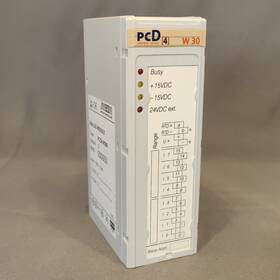
( Brand: Saia ), ( Manufacturer Part Number: PCD4.W300 ), ( Part Type: Control Module Device ), ( Analog/digital: Analog )
Review SAIA Versionanalog Input Module Control Device
The **SAIA PCD4.W300 Analog Module Control Device** is a high-performance, modular control unit designed to integrate seamlessly into industrial automation systems, offering advanced functionality for precise process and machine control. Part of SAIA s robust PCD4 series, this analog module serves as a versatile interface for connecting and managing a wide range of analog input and output signals, making it an ideal solution for applications requiring real-time data acquisition, monitoring, and actuation. With its compact yet rugged design, the PCD4.W300 is built to withstand demanding environments, featuring IP65 protection and a wide operating temperature range, ensuring reliable operation in factories, manufacturing plants, and automated production lines.
At its core, the PCD4.W300 supports a variety of analog signals, including 4-20 mA, 0-20 mA, 0-10 V, and 0-24 V inputs and outputs, allowing for flexible integration with sensors, actuators, and other field devices. Its modular architecture enables easy expansion and customization, accommodating different signal types and quantities through compatible analog modules, while its high-resolution analog-to-digital conversion ensures accurate signal processing with minimal noise interference. The device is equipped with advanced diagnostic features, including signal monitoring, fault detection, and status reporting, which enhance system reliability and simplify troubleshooting.
The PCD4.W300 is designed for seamless integration with SAIA s PCD4 programmable logic controllers (PLCs) and other industrial automation platforms, leveraging standardized communication protocols such as PROFIBUS DP, PROFINET, and Ethernet/IP to facilitate efficient data exchange. Its intuitive configuration tools, accessible via user-friendly software interfaces, allow engineers and technicians to quickly set up and parameterize analog channels, define scaling factors, and configure alarm thresholds all while maintaining compliance with industry standards for safety and performance. Whether used for process control in chemical plants, motion control in packaging machinery, or environmental monitoring in HVAC systems, the PCD4.W300 delivers the precision, flexibility, and durability required to meet the most demanding automation challenges.
### **Pros and Cons of buying a SAIA PCD4.W300 Analog Module Control Device**
#### **Pros:**1. **Versatile Analog Input/Output Control** The PCD4.W300 supports multiple analog inputs (0-10V, 4-20mA, RTD, thermocouples) and outputs, making it suitable for process control, automation, and monitoring applications where precise analog signal handling is required.
2. **Modular and Expandable Design** It integrates seamlessly with SAIA s PCD4 series, allowing for easy expansion with additional modules (digital I/O, communication interfaces, etc.), enhancing system flexibility without major redesigns.
3. **High Reliability and Industrial Build** Designed for harsh industrial environments, it offers robust protection against electrical noise, temperature fluctuations, and mechanical stress, ensuring long-term operation in factories, plants, or outdoor installations.
4. **Comprehensive Communication Options** Supports protocols like **PROFIBUS DP, CANopen, Modbus RTU/ASCII**, and **Ethernet/IP**, making it compatible with most PLCs, SCADA systems, and automation networks, reducing integration challenges.
5. **Precise Signal Conditioning** Built-in filtering, scaling, and linearization ensure accurate analog signal processing, reducing errors in measurements (e.g., temperature, pressure, flow) critical for quality control and safety applications.
6. **Easy Configuration and Diagnostics** SAIA s software tools (e.g., **SAIA Configurator**) simplify parameter setup, monitoring, and fault diagnostics, reducing downtime and maintenance complexity.
7. **Backward and Forward Compatibility** Works with existing SAIA systems and supports future upgrades, minimizing the need for costly replacements as technology evolves.
8. **Low Latency for Real-Time Control** Optimized for applications requiring fast response times, such as motor control, robotics, or closed-loop systems where analog feedback is essential.
9. **Reduced Wiring Complexity** Consolidates multiple analog signals into a single module, simplifying cable management and reducing installation time and costs.
10. **Vendor Support and Documentation** SAIA is a well-established brand in industrial automation, offering reliable technical support, training, and extensive documentation for troubleshooting and implementation.
---
#### **Cons:**1. **Higher Initial Cost** Compared to generic analog I/O modules from less-known brands, the PCD4.W300 may have a premium price, which could be a barrier for small-scale or budget-constrained projects.
2. **Limited Analog Channels** Depending on the specific variant, it may not offer as many analog inputs/outputs as some competitors (e.g., 32-channel modules from other manufacturers), potentially requiring additional modules for high-density applications.
3. **Learning Curve for Configuration** While SAIA s tools are user-friendly, users unfamiliar with industrial automation protocols or SAIA s software may require training, adding time to implementation.
4. **Dependency on SAIA Ecosystem** If the system relies heavily on SAIA modules, switching to a different brand later could complicate upgrades or replacements, locking users into a proprietary environment.
5. **Physical Size and Space Requirements** As a rack-mounted or DIN-rail module, it may occupy more space than compact, standalone analog I/O devices, which could be a constraint in tight installation areas.
6. **Potential Overkill for Simple Applications** For very basic analog control (e.g., a single temperature sensor), a simpler, cheaper module might suffice, making the PCD4.W300 an unnecessary investment.
7. **Firmware/Software Updates** Like many industrial devices, updates may require downtime or careful planning to avoid disrupting operations, which could be inconvenient for critical systems.
8. **Limited Global Availability** Depending on the region, distribution and support may not be as extensive as for more universally adopted brands (e.g., Siemens, Allen-Bradley), potentially delaying parts or service.
---
### **Conclusion**
The **SAIA PCD4.W300 Analog Module Control Device** is a **high-quality, reliable, and versatile** solution for industrial applications requiring precise analog signal handling. Its strengths lie in **integration with SAIA s ecosystem, robust build quality, and support for multiple communication protocols**, making it ideal for **process automation, machine control, and SCADA systems** where accuracy and scalability are critical.
However, its **higher cost, potential overkill for simple applications, and dependency on SAIA s platform** may not justify the purchase for **small-scale or cost-sensitive projects**. Users should carefully assess their **specific analog I/O requirements, budget, and long-term system needs** before deciding.
### **Recommendation**
- **Buy the PCD4.W300 if:**- You are already using SAIA s automation platform and need seamless integration.
- Your application demands **high-precision analog control** (e.g., temperature, pressure, flow monitoring in industrial processes).
- You require **multiple communication protocols** (PROFIBUS, CANopen, Modbus, etc.) and modular expandability.
- Reliability and **long-term support** are priorities in a harsh industrial environment.
- **Consider alternatives if:**- You need **a large number of analog channels** (e.g., 16 inputs/outputs) and want a more cost-effective solution.
- Your project is **small-scale or budget-constrained**, and a simpler, cheaper module (e.g., from Beckhoff, Phoenix Contact, or generic brands) meets your needs.
- You prefer **vendor-neutral** or **open-standard** solutions to avoid proprietary lock-in.
For most **mid-to-large industrial automation projects** where **compatibility, precision, and scalability** are key, the **SAIA PCD4.W300 is a strong recommendation**. For simpler or cost-sensitive applications, evaluating alternatives may yield better value.
Details:
SAIA PCD4.W300 Version Analog Input Module Control Device.
part #: pcd4w300 prices
- $90.29-$865.00
specifications sensoindustria:
- brand: Saia
- mpn: Pcd4.w300
- part type: Control Module Device
- analog/digital: Analog
seller sensoindustria:
- # reviews: 2109
- city: Bloomer, Wisconsin
- rating: 100.0%
offer sensoindustria:
- sold: 0
- quantity: 1
- availability: In Stock
- options: Ship-to-home
- started: February 14, 2026
- best offers: True
payments sensoindustria:
- wallet: Google-pay
- credit card: Discover
- other
returns sensoindustria:
- paid by: Buyer
- method: Money back
- policy: Returns Accepted
- time: 30 Days
general sensoindustria:
- condition: Used
- PLCs HMIs > PLC Peripheral Modules > PLC Input Output Modules
shipping sensoindustria:
- service: USPS Ground Advantage, USPS Priority Mail
- transit: 5-9 Days
- type: Calculated
- class: Standard, Expedited
- cost: $0.00
- carrier: USPS
Saia PCD4.W300 Is Similar To:
- Saia Burgess Pcd3.a460 Digital Output Module 16 (49.1% similar) You are buying on the item listed in title. Sometimes my may be brief, but I put most of time and effort in providing numerous high quality images the item being listed. Shipping and packing material is not factored into shipping comes out of my pocket. As always I try to give as many pictures for ...(October 3rd, 2024)
- Saia Burgess Pcd2.c150 Saia-burgess Controler Module (43.2% similar) Unit is in good working condition. There item is used...(November 13th, 2024)
- Saia Pcd3.a400 Burgess Output Module (52.6% similar) Part #: Saia PCD3.A400 for sale...(February 11th, 2025)
- Saia Burgess Pcd3.w525 Used I o Module Pcd3 Series Analog With Galvanic Isolatio (38.8% similar) Used Saia Burgess PCD3.W525 i/o module PCD3 series analog w/ galvanic isolation...(September 10th, 2025)
- Saia-burgess Pcd2.m157 Saia-burgess Control Module Pcd2m157 24vdc Used (38.8% similar) Item id: 547443-43/B/02: condition note: is used in good working condition, 60 day money back guarantee. Shipping information. Make sure the particular listing states world wide shipping or ask before purchasing. Values will not be lowered on custom forms or marked as ts...(November 5th, 2025)
- Saia-burgess Pcd3.w610 Saia-burgess Digital Transistor Input Module Used (50.4% similar) Saia-Burgess PCD3.W610 digital transistor input module used. Condition is used. Shipped with ups ground...(December 4th, 2025)
- Saia Pcd4.m140 Cpu V004 Processor Module With Memory (43.2% similar) Msrp: $599.99. Mpn: PCD4.M140. We choose the carrier. Local pick-up, prefer to pick it up yourself. Next day second air services are available. Your phone number and business name. Items in lot: country of manufacture: Switzerland. Model: CPU: V004. Condition: used. After the return period has ended...(March 25th, 2026)
- Saia Pcd4.w110 Analog Input Output Module 24vdc (66% similar) Country of manufacture: Switzerland. Need it urgently. Next day second air services are available. Msrp: $39.99. Mpn: PCD4.W110. We choose the carrier. All goods are so as is' and with all faults meaning, without limitation, that. Items in lot: condition: used. Consignee: your phone number and ...(April 1st, 2026)
