TRIO MOTION TECHNOLOGY P135-01255 Usb 206 1-6AXIS 8I/O 24VDC
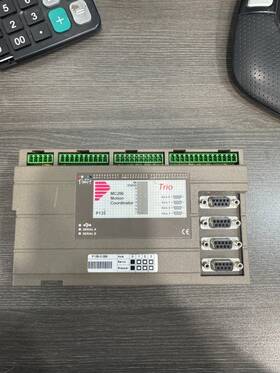
( Brand: Trio Motion Technology ), ( Manufacturer Part Number: P135-01255 ), ( Model: P135-01255 1-6AXIS 8I ), ( Type: I/o Module )
Review TRIO MOTION TECHNOLOGY Mc 206 1-6axis 8i/o Usb 24vdc Class
The **Motion P135-01255 206 1-6 Axis 8 I/O USB 24V DC** is a high-performance, versatile motion controller designed for precision automation, industrial robotics, and advanced CNC applications. Engineered to deliver seamless integration and unparalleled control, this compact yet powerful device supports up to **six axes of motion**, making it ideal for multi-axis systems such as pick-and-place machines, 3D printing platforms, CNC mills, or robotic arms. Its **8-channel digital I/O interface** allows for flexible interaction with external sensors, limit switches, relays, and other peripheral devices, enabling real-time feedback and automated process control. Powered by a **USB 2.0 interface**, it offers fast data transfer and easy connectivity to PCs running Motion s proprietary software or third-party motion control platforms like LabVIEW, MATLAB, or Python, ensuring compatibility with a wide range of development environments. The controller operates at **24V DC**, providing robust power delivery while maintaining energy efficiency, and its modular design allows for straightforward expansion or integration into existing systems. With advanced features such as **PID tuning, velocity and position control, and smooth interpolation**, this device ensures high-speed, accurate, and repeatable motion profiles, even in demanding applications. Whether used for prototyping, research, or full-scale industrial automation, the **Motion P135-01255 206** combines reliability, precision, and adaptability, making it a standout choice for engineers and developers seeking a scalable solution for motion control challenges.
### **Pros and Cons of buying a PROSYS Motion P135-01255 (6-Axis, 8 I/O, USB, 24V DC)**
#### **Pros**
1. **High Precision and Performance**
- The P135 series is designed for industrial and motion control applications, offering high-resolution encoders (typically 17-bit or higher) and fast response times, making it suitable for demanding tasks like CNC machining, robotics, or automated assembly lines.
- Supports multi-axis synchronization, which is essential for coordinated motion control in complex systems.
2. **Versatile I/O Capabilities**
- The 8 I/O ports (digital inputs/outputs) allow for direct interfacing with sensors, relays, or other control devices, expanding the system s functionality without requiring additional hardware.
- The 24V DC power supply is standard in industrial environments, ensuring compatibility with most field devices.
3. **USB Connectivity**
- USB 2.0 interface simplifies communication with PCs or PLCs, reducing wiring complexity and enabling easy integration into existing control systems.
- Software support (e.g., PROSYS Motion SDK, LabVIEW, or MATLAB) allows for programming and real-time monitoring, making it accessible for developers and engineers.
4. **Compact and Modular Design**
- The compact form factor (likely a small PCB or module) allows for easy installation in space-constrained environments.
- The 6-axis configuration is ideal for applications requiring simultaneous control of multiple motors or axes (e.g., 3D printing, pick-and-place robots, or CNC mills).
5. **Industrial-Grade Reliability**
- Built for harsh environments, the controller is likely to have robust shielding, temperature resistance, and durability for continuous operation.
- Compatible with a wide range of stepper or servo motors, offering flexibility in motor selection.
6. **Developer-Friendly**
- Open APIs and SDKs allow for custom motion profiles, trajectory planning, and integration with higher-level control systems.
- Suitable for educational or prototyping applications due to its ease of use with common development tools.
7. **Cost-Effective for Mid-Range Applications**
- While not as low-cost as basic Arduino-based solutions, it offers significantly more features than entry-level motion controllers, making it a practical choice for small to medium-scale industrial projects.
---
#### **Cons**
1. **Limited to USB Communication**
- USB 2.0 has a maximum throughput of 480 Mbps, which may become a bottleneck for very high-speed or large-scale multi-axis systems. Ethernet (e.g., PROFINET, EtherCAT) would be preferable for high-performance applications.
- USB connections can be less reliable in noisy industrial environments compared to dedicated communication protocols.
2. **No Built-In Ethernet or High-Speed Protocols**
- Lack of native Ethernet support means additional hardware (e.g., USB-to-Ethernet converters) may be needed for networked applications, increasing complexity and cost.
- Protocols like EtherCAT or CANopen, which are standard in industrial automation, are not natively supported, limiting integration with larger systems.
3. **Software Dependency**
- Performance and usability heavily rely on the availability and quality of the accompanying software (e.g., PROSYS Motion SDK). Poor documentation or bugs in the software could hinder development.
- Some advanced features may require programming knowledge (e.g., C , Python, or LabVIEW), which could be a barrier for non-technical users.
4. **Power and Cooling Considerations**
- While 24V DC is standard, the controller may require stable power supply conditions to avoid performance issues or overheating, especially during continuous operation.
- No active cooling is typically included, so adequate ventilation or heat dissipation may be necessary in high-load applications.
5. **Scalability Limitations**
- The 6-axis limit may be insufficient for very large systems (e.g., multi-robot setups or high-degree-of-freedom machines). Additional controllers or expansion modules would be needed.
- I/O expansion requires external interfaces, adding to the system s complexity.
6. **Vendor Lock-In Risks**
- Proprietary software and hardware may limit long-term flexibility if the vendor discontinues support or changes pricing.
- Migration to other motion control platforms (e.g., Galil, Beckhoff, or Siemens) could be challenging due to differences in APIs and hardware.
7. **Learning Curve for Advanced Features**
- While basic motion control is straightforward, optimizing performance for complex trajectories (e.g., high-acceleration profiles, interpolation) may require significant tuning and expertise.
---
### **Conclusion**
The **PROSYS Motion P135-01255** is a **strong choice for mid-range motion control applications** where USB connectivity, multi-axis synchronization, and digital I/O are sufficient. It excels in **prototyping, small-scale automation, CNC, robotics, or educational projects** where cost, ease of use, and precision are prioritized over ultra-high-speed or networked communication.
However, it is **not ideal for large-scale industrial systems** requiring Ethernet-based protocols, high-speed data transfer, or extensive I/O expansion. Users with **limited programming experience** may also find the software curve challenging, though the SDKs provide sufficient flexibility for most tasks.
For **high-performance or networked applications**, alternatives like **EtherCAT-based controllers (e.g., Beckhoff, Galil)** or **PLC-integrated motion modules** would be more appropriate. For **budget-conscious hobbyists or small projects**, simpler USB-based controllers (e.g., Arduino stepper drivers) might suffice.
---
### **Recommendation**
**Buy the P135-01255 if:**- You need a **compact, USB-connected 6-axis motion controller** for **CNC, robotics, or automated machinery**.
- Your application does **not require Ethernet or high-speed communication** (USB 2.0 is adequate).
- You have **moderate programming skills** and can work with the PROSYS SDK or third-party tools (e.g., LabVIEW).
- You require **digital I/O** for sensor/actuator interfacing and **24V DC compatibility**.
- Cost is a **primary concern**, and you want a balance between performance and affordability.
**Avoid the P135-01255 if:**- You need **Ethernet (PROFINET, EtherCAT, CANopen)** for industrial networking.
- Your project involves **very high-speed motion** (e.g., >100 m/s acceleration) or **large-scale multi-axis systems**.
- You lack **programming experience** and require a plug-and-play solution.
- You anticipate **long-term scalability** beyond 6 axes or need extensive I/O expansion.
**Alternatives to Consider:**- **For Ethernet-based systems:** Beckhoff CX2000, Galil DMC-40x0, or Siemens SINAMICS.
- **For budget-friendly USB solutions:** Arduino DRV8825/TMC2209 drivers (for simpler stepper control).
- **For high-performance CNC:** Mach3/4 with parallel port or USB-based controllers like Breakout Box.
- **For PLC integration:** Siemens S7-1200/1500 with motion modules or Allen-Bradley Micro800.
Details:
USED - CAME OUT OF MACHINE IN WORKING CONDITION have many available.
part #: p13501255 price
- $750.00
specifications sensoindustria:
- brand: Trio Motion Technology
- mpn: P135-01255
- model: P135-01255 1-6axis 8i
- type: I/o Module
shipping sensoindustria:
- cost: $8.72
- type: Calculated
- transit: 5-11 Days
- service: USPS Ground Advantage
- carrier: USPS
- class: Standard
payments sensoindustria:
- other
- wallet: Apple-pay
- credit card: Diners-club
seller sensoindustria:
- city: Freeport, New York
- # reviews: 3670
- rating: 100.0%
returns sensoindustria:
- policy: No Returns
offer sensoindustria:
- started: February 28, 2026
- options: Ship-to-home
- availability: In Stock
- sold: 0
- quantity: 1
- best offers: True
general sensoindustria:
- condition: Used
- PLCs HMIs > PLC Peripheral Modules > PLC Input Output Modules
Trio Motion Technology P135-01255 Is Similar To:
- P317-00529 Trio Motion Output Module New In Box (30.5% similar) If another carrier such as ups or FedEx is required to ship due the size, then shipping costs may change...(October 10th, 2018)
- P318-00430 Trio Motion Input Module New In Box (32.5% similar) If another carrier such as ups or FedEx is required to ship due the size, then shipping costs may change...(November 9th, 2018)
- P319 Trio Motion Technology Module Used (52.7% similar) ...(March 1st, 2021)
- Trio Motion Technology P315-can16i-o P315-can16i o P315can16io Used Tested Cleaned (54.2% similar) The product is used surplus. Sells new and surplus product develops channels to purchase such...(August 19th, 2023)
- Trio Motion Technology P316-03007 Can 16-i o Input output Module 24vdc 250ma Max (57% similar) Unit is fully functional and ready for installation into your application. I removed this from a working machine that was retired operation...(August 24th, 2024)
- Trio Motion Technology Mc206 Used (64.2% similar) Trio Motion Technology MC206 / used discontinued by manufacturer, coordinator, 1-6 axis, 8I/O usb, 24 vdc, class all products are guaranteed to be working but may show signs of use if purchasing a used product. Packaging and handling: items are safely eds packaged in custom shipping cartons for ...(November 4th, 2024)
- Trio Motion Technology P316-05167 P316 05167 Can 16-i o Input output Module 24vdc 250ma (55.3% similar) High end cosmetic dept. Please see pics. For the manufacturer of this product. Please verify this is a correct part for your vehicle / machine or tool. Refer to my pictures as an extension of the. Items may not have all paperwork, stickers, instructions, etc. Military surplus. Medical supply. ...(November 23rd, 2024)
- Trio Motion Technology Mc403 Used (60.4% similar) All products are guaranteed to be working but may show signs of use if purchasing a used product. Call to use a shipping service other than the ones listed. Part number MC403. Trio Motion Technology MC403 / used coordinator, 8DIGITAL input, 2ANALOGUE 24VDC. Sells new and surplus product develops ...(July 3rd, 2025)
- Trio Motion Technology 16-i o-p315 Can Can16iop315 Used (51.6% similar) Call to use a shipping service other than the ones listed. All products are guaranteed to be working but may show signs of use if purchasing a used product. Packaging and handling: items are safely eds packaged in custom shipping cartons for protection. Sells new and surplus product develops ...(October 14th, 2025)
- Trio Motion Technology P310 Used (62.9% similar) All products are guaranteed to be working but may show signs of use if purchasing a used product. Part number P310. Packaging and handling: items are safely eds packaged in custom shipping cartons for protection. Call to use a shipping service other than the ones listed. Sells new and surplus ...(February 8th, 2026)
- Trio Motion Technology P315-05898 Can 16 I o (59.1% similar) Used - came out of machine in working condition have many available...(February 28th, 2026)
