NATIONAL INSTRUMENTS GPIB-140A Fiber Optic Extender Gpib BFR30
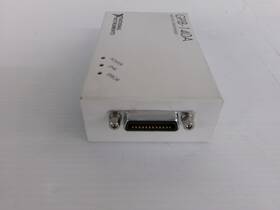
( Brand: National Instruments ), ( Manufacturer Part Number: GPIB-140A ), ( Part Type: Extender )
Review NATIONAL INSTRUMENTS Fiber Optic Gpib Extender
The **National GPIB-140A Fiber Optic GP-IB Extender (BFR30)** is a high-performance, industry-leading solution designed to extend and enhance the connectivity of IEEE-488 (GPIB) instrumentation systems over long distances while maintaining signal integrity and reliability. Engineered for environments where traditional coaxial cabling is impractical such as in laboratories, manufacturing plants, or distributed test setups the GPIB-140A leverages cutting-edge fiber optic technology to eliminate electromagnetic interference (EMI), signal degradation, and ground loop issues that often plague conventional GP-IB connections. This extender operates at a robust data transfer rate of up to 1 Mbps, ensuring seamless communication between instruments and controllers, even when separated by hundreds of meters. Its dual-fiber optic ports (one for transmission and one for reception) allow for bidirectional communication, enabling full-duplex operation without latency, which is critical for complex test and measurement applications. The unit features a rugged, compact design with robust mounting options, including DIN-rail or panel-mount configurations, making it ideal for integration into existing instrumentation racks or custom setups. Additionally, the GPIB-140A is fully compliant with IEEE-488.2 standards, ensuring compatibility with a vast array of GPIB-compatible devices, from oscilloscopes and spectrum analyzers to data acquisition systems and automated test equipment. Whether deployed in a high-noise industrial setting or a precision-controlled laboratory, this extender guarantees stable, high-speed communication, reducing downtime and improving the accuracy of automated testing processes. Its low-latency performance and immunity to electrical noise make it an indispensable tool for engineers and technicians who demand reliability in demanding environments.
The **National GPIB-140A Fiber Optic GP-IB Extender (BF-R30)** is a device designed to extend the reach of a GPIB (IEEE-488) bus over fiber optic cables, enabling longer cable runs and improved signal integrity. Below is a detailed breakdown of its pros and cons, followed by a conclusion and recommendation.
---
### **Pros**
1. **Extended Cable Reach**
The primary advantage of this extender is its ability to significantly increase the maximum cable length of a GPIB bus. Standard GPIB cables are limited to about 20 meters due to signal degradation, but fiber optic cables can extend this to hundreds of meters (depending on the setup). This is particularly useful in industrial or laboratory environments where instruments need to be placed far apart.
2. **Improved Signal Integrity**
Fiber optic cables are immune to electromagnetic interference (EMI) and radio frequency interference (RFI), which can corrupt signals in traditional coaxial GPIB cables. This results in more reliable data transmission, especially in noisy environments.
3. **Future-Proofing**
Fiber optic technology is widely used in modern communication systems and is less susceptible to obsolescence compared to older copper-based solutions. This extender can be part of a longer-term infrastructure upgrade.
4. **Compatibility with Existing Systems**
The GPIB-140A is designed to work with standard GPIB instruments, requiring minimal changes to existing setups. It maintains backward compatibility, making it easier to integrate into legacy systems without requiring new hardware or software.
5. **Modular and Scalable**
The extender can be used to create a segmented GPIB network, allowing for the connection of multiple instruments across different locations. This modularity can simplify wiring and reduce clutter in complex setups.
6. **Low Latency**
Fiber optic cables generally introduce minimal latency compared to some other high-speed communication methods, ensuring that timing-sensitive operations (e.g., automated testing) remain efficient.
7. **Durability**
Fiber optic cables are physically robust and resistant to environmental factors like moisture, temperature fluctuations, and physical stress, which can degrade copper cables over time.
---
### **Cons**
1. **High Cost**
Fiber optic GPIB extenders are significantly more expensive than standard GPIB cables or passive extenders. The GPIB-140A is no exception, and the cost may not be justified for small-scale or low-budget setups where the distance requirements are minimal.
2. **Complex Installation**
Setting up a fiber optic GPIB network requires careful planning, including proper termination of fiber optic cables, alignment of connectors, and potentially the use of specialized tools. This can add time and labor costs to the installation process.
3. **Limited Availability of Fiber Optic GPIB Solutions**
Unlike standard GPIB cables, fiber optic GPIB extenders are less commonly available. This can make troubleshooting or finding replacement parts more difficult. Additionally, not all GPIB instruments may support or benefit from fiber optic extensions, depending on their power requirements or signal characteristics.
4. **Power Requirements**
Some GPIB instruments require power to be supplied over the GPIB bus (e.g., for active terminators or certain controllers). While the GPIB-140A supports power-over-GPIB (POG) in some configurations, not all fiber optic extenders do, and this may limit compatibility with certain devices.
5. **Potential for Signal Degradation in Poorly Configured Systems**
Although fiber optic cables themselves are immune to EMI, improper termination, excessive bending of the cables, or using low-quality connectors can introduce signal issues. This requires careful attention to installation details.
6. **Learning Curve**
Users unfamiliar with fiber optic technology may need time to understand how to properly configure, test, and maintain the system. This could lead to initial inefficiencies or mistakes during setup.
7. **Limited Support for High-Speed Data Transfers**
While the GPIB-140A supports standard GPIB speeds (up to 1 Mbps in most cases), fiber optic GPIB extenders are not designed for high-speed data transfers like those required by modern digital interfaces (e.g., USB, Ethernet). If high-speed data acquisition is a requirement, alternative solutions (e.g., Ethernet-based instrument interfaces) may be more appropriate.
---
### **Conclusion**
The **National GPIB-140A Fiber Optic GP-IB Extender (BF-R30)** is a powerful tool for extending the reach and reliability of a GPIB bus in environments where signal integrity and long cable runs are critical. Its ability to eliminate EMI, support extended distances, and maintain compatibility with existing GPIB systems makes it ideal for industrial, laboratory, or automated testing applications where traditional GPIB limitations would otherwise be a bottleneck.
However, the high cost, complexity of installation, and potential compatibility issues with certain instruments or power requirements may make it less suitable for small-scale or budget-conscious setups. Additionally, if the application involves high-speed data transfers or requires modern interfaces, alternative solutions may be more appropriate.
---
### **Recommendation**
- **Buy the GPIB-140A if:**- You are working in an environment where GPIB instruments are spread out over long distances (e.g., 50 meters or more).
- Signal integrity is a concern due to electromagnetic interference (e.g., in industrial or noisy laboratory settings).
- You need a reliable, long-term solution that avoids the limitations of copper GPIB cables.
- Your budget can accommodate the higher cost of fiber optic GPIB extenders, and you have the technical resources to install and maintain the system properly.
- **Avoid the GPIB-140A if:**- Your GPIB setup requires only short cable runs (under 20 meters), where standard GPIB cables would suffice.
- You are working with a limited budget and can find alternative solutions (e.g., using Ethernet-based instrument interfaces like VXI-11 or PXI).
- Your instruments have specific power or signal requirements that are not fully supported by the extender.
- You lack the technical expertise to properly install, configure, or troubleshoot fiber optic GPIB systems.
- **Alternatives to Consider:**- For shorter distances, use standard GPIB cables or passive extenders.
- For modern applications, consider transitioning to Ethernet-based instrument interfaces (e.g., LAN-based instruments with VXI-11 or PXIe support), which offer higher speeds, better scalability, and easier integration with contemporary software and hardware.
- If you need to extend GPIB over copper but want to reduce EMI, consider using shielded twisted-pair (STP) GPIB cables or active GPIB repeaters.
Details:
Power cord is not included. Acquired from a reliable source. No means to test further. Used items have a 30-day return.
Has some cosmetic wear.
part #: gpib140a price
- $562.50
specifications sensoindustria:
- brand: National Instruments
- mpn: Gpib-140a
- part type: Extender
offer sensoindustria:
- availability: In Stock
- options: Ship-to-home
- quantity: 1
- best offers: True
- started: April 13, 2026
- sold: 0
shipping sensoindustria:
- service: USPS Priority Mail
- transit: 3-7 Days
- type: Fixed
- carrier: USPS
- class: Expedited
- cost: $13.25
returns sensoindustria:
- time: 30 Days
- policy: Returns Accepted
- method: Money back
- paid by: Seller
seller sensoindustria:
- city: Bosque Farms, New Mexico
- # reviews: 57333
- rating: 99.9%
payments sensoindustria:
- wallet: Google-pay
- other
- credit card: Visa
general sensoindustria:
- Analyzers Data Acquisition > Data Acquisition Loggers > GPIB Interfaces Adapters
- condition: Used
National Instruments GPIB-140A Is Similar To:
- 182417-01 National Instruments Scxi-1325 Screw (46.3% similar) Used and in perfect working order. The winning bidder pays 7SINS in us lower 48 states via USPS priority mail. This listing is for one National Instruments SCXI-1325 screw terminal block. Comes as shown with no accessories...(July 12th, 2017)
- 182469c-01 National Instruments Shielded Connector Block (47.5% similar) With a 68 pin connector to accept the cable coming from your FAQ board screw terminals for I o devices. The SCB-68 is an interface device for several of National Instruments FAQ cards. This is a fully functional unit. Guaranteed not DOA...(January 7th, 2019)
- 184437c-02 National Instruments Ni Cfp-di-301 (48.6% similar) ...(January 1st, 2018)
- 185185a-01 National Instruments Module New (46.2% similar) See photos and. New National Instruments 185185A-01 I o module UL94V-0 manufacture: model: 185185A-01I other NUMBERS:PCI-6503 assay condition: this is but not sealed in original package...(January 6th, 2019)
- 189200d-01 Ni National Instruments 9472 (43.6% similar) Guaranteed not DOA...(November 17th, 2017)
- 194918a National Instruments Ni Pxi-1033 (51% similar) National Instruments Ni PXI-1033 pix chassis 194918A...(May 22nd, 2017)
- 199364b-01l 1b513d7 National Instruments Digital Output Module (46.8% similar) Please see my other listings for a CRIO-9025 real-time controller, Ni 9201 analog input module and NI-9421 digital. Each channel is compatible with signals from 6 v to 30 v, features transient over voltage protection between the output channels and back plane, has an led that indicates status. ...(May 5th, 2018)
- 776229-10 National Instruments Voltage Input Module (42.5% similar) I try to schedule offers end when am where the item is. Shipping prices quoted are for the contiguous USA. Listing is for one module. I live in two different cities. Feel free to ask any questions...(June 22nd, 2018)
- 777318-421 National Instruments Cfp-rly-421 Ni (42.6% similar) ...(October 27th, 2017)
- 778069-08 National Instruments Instrument Fieldpoint Terminal Analog Input Module (40.6% similar) which do not in any way affect the functionality or performance of item. Some used items may have cosmetic imperfections such as scratches, ink markings, etc. This item has been described to the best of our ability. Happy buying. They may therefore have minor wear commensurate with age and usage...(August 27th, 2018)
- 778069-21 National Instruments Instrument Analog Thermocouple Input Module (39.7% similar) Which do not in any way affect the functionality or performance of item. This item has been described to the best of our ability. Happy buying. They may therefore have minor wear commensurate with age and usage. Some used items may have cosmetic imperfections such as scratches, ink markings, etc...(August 27th, 2018)
