EASYIO EASYIO-J2 Plc Modules
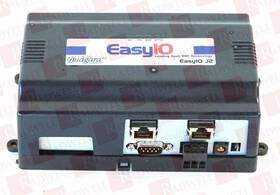
( Brand: Easyio ), ( Manufacturer Part Number: EASYIO-J2 ), ( Part Type: Module )
Review EASYIO Easyioj2 Used
The **EasyIO J2 (Model: EasyIO-J2)** is a versatile and compact industrial-grade I/O module designed to simplify automation, control, and data acquisition tasks for engineers, hobbyists, and professionals working with PLCs, microcontrollers, or standalone systems. Engineered with precision and ease of use in mind, this module bridges the gap between digital and analog signals, offering a seamless integration solution for applications ranging from robotics and CNC machining to home automation and IoT projects. Its robust construction ensures reliability in demanding environments, featuring a durable metal enclosure with screw terminals for secure and stable connections, reducing the risk of loose wires or signal interference a common issue in dynamic or high-vibration settings. The EasyIO J2 stands out with its **24-bit resolution** for analog inputs, delivering unparalleled accuracy and sensitivity, which is critical for applications requiring precise measurements such as temperature monitoring, pressure sensing, or motor speed control. Its **16 digital I/O channels** (configurable as inputs or outputs) provide flexibility for controlling relays, LEDs, sensors, or interfacing with other devices, while the **4 analog inputs** (0 10V or 0 5V compatible) and **2 analog outputs** (0 10V) enable seamless interaction with a wide range of transducers and actuators. The module s **RS-485 communication interface** ensures long-distance data transmission with minimal signal degradation, making it ideal for distributed systems or environments where wired connections are impractical. Additionally, the EasyIO J2 supports **Modbus RTU protocol**, allowing it to communicate effortlessly with most industrial controllers, PLCs, or even Raspberry Pi-based systems via simple serial commands, reducing the need for complex programming or additional hardware. Its **low-power design** and **wide operating voltage range (9 30V DC)** further enhance its adaptability, ensuring consistent performance across diverse power supply scenarios. Whether deployed in a factory floor, a research lab, or a DIY project, the EasyIO J2 combines **simplicity, performance, and expandability**, making it an indispensable tool for anyone seeking a reliable, all-in-one solution for digital and analog signal management. With its intuitive wiring and straightforward documentation, it empowers users to focus on their core application logic rather than troubleshooting connectivity issues, ultimately accelerating development and deployment cycles.
### **Pros and Cons of buying a EasyIO (EasyIO-J2/EasyIO-J2) Module**
The **EasyIO-J2** (and its predecessor, the **EasyIO**) is a popular open-source, modular I/O expansion board designed for Arduino, Raspberry Pi, and other microcontroller platforms. It provides a flexible way to add digital, analog, and communication interfaces (UART, SPI, I2C) to projects without cluttering the main board. Below is a detailed breakdown of its advantages and disadvantages.
---
### **Pros of the EasyIO-J2**
1. **Modular and Expandable Design**
- The EasyIO-J2 follows a **stackable, plug-and-play** architecture, allowing users to connect multiple modules (e.g., relays, sensors, motor drivers) via screw terminals or screwless connectors.
- Supports **hot-swapping** modules can be added or removed without powering down the system, making it ideal for prototyping and field testing.
- Compatible with a **wide range of third-party modules** (e.g., relays, LEDs, temperature sensors, CAN bus adapters), expanding functionality beyond stock features.
2. **Versatile I/O Options**
- Provides **digital I/O (up to 16 pins)**, **analog inputs (up to 8 channels)**, and **communication interfaces (UART, SPI, I2C)**.
- Includes **PWM outputs** for controlling motors, LEDs, and other devices with adjustable speed.
- Some modules (like the **EasyIO-J2 Relay**) offer **high-current switching** (up to 10A per relay), useful for controlling appliances or actuators.
3. **Open-Source and Community-Driven**
- The design is **open-source**, with schematics, firmware, and documentation available on platforms like GitHub.
- A **large community** supports troubleshooting, custom modifications, and shared projects, reducing reliance on proprietary solutions.
- Libraries (e.g., Arduino, Python) are well-documented, making integration straightforward for beginners and experts alike.
4. **Cost-Effective for Small Projects**
- Individual modules (e.g., relay, sensor, or motor driver) are often **cheaper than building custom circuits** from scratch.
- Avoids the need for a breadboard or prototyping board, reducing material costs for simple setups.
- Bulk discounts are available for larger orders, making it economical for educational or commercial use.
5. **Easy Integration with Popular Platforms**
- Works seamlessly with **Arduino, Raspberry Pi, ESP32, STM32, and other microcontrollers** via standard interfaces (UART, SPI, I2C).
- Supports **multiple programming languages** (Arduino IDE, PlatformIO, Python with GPIO libraries), offering flexibility for different use cases.
- Some modules include **built-in voltage regulation**, ensuring stable power delivery to connected devices.
6. **Durable and Reliable**
- Uses **screw terminals or screwless connectors**, which are more robust than jumper wires for long-term projects.
- The PCB is designed for **low power consumption**, reducing heat generation and extending component lifespan.
- Many users report **minimal firmware bugs**, with updates regularly released by the community.
7. **Educational Value**
- Ideal for **teaching electronics and programming** due to its simplicity and clear documentation.
- Encourages **modular thinking** in hardware design, helping learners understand how components interact.
- Projects can be easily scaled from simple sensors to complex automation systems.
8. **No Soldering Required**
- Most modules use **pre-assembled connectors**, eliminating the need for soldering for basic setups.
- Users can focus on **software and logic** rather than hardware assembly, speeding up development.
9. **Remote Monitoring and Control Capabilities**
- When paired with a **Raspberry Pi or ESP32**, the EasyIO-J2 can enable **IoT applications** (e.g., home automation, environmental monitoring).
- Supports **MQTT, HTTP, or WebSocket** protocols for cloud connectivity, making it useful for smart systems.
10. **Backward Compatibility**
- The **EasyIO-J2** is an upgraded version of the original **EasyIO**, maintaining compatibility with older modules while adding improvements (e.g., better connectors, expanded I/O).
- Existing projects can often be **migrated with minimal changes**.
---
### **Cons of the EasyIO-J2**
1. **Limited High-Power Capabilities**
- While some modules (e.g., relays) support **10A or 16A**, the main EasyIO-J2 board itself **cannot handle high currents** connected devices must manage their own power.
- For **high-power applications** (e.g., driving motors >20A), additional external power supplies or drivers (e.g., MOSFETs, relays) are required.
- **Analog inputs** have limited resolution (typically 10-bit), which may not be sufficient for precision measurements (e.g., high-accuracy sensors).
2. **Dependence on Community Support**
- Since it s open-source, **official support is minimal** users must rely on forums (e.g., GitHub, Arduino forums) for troubleshooting.
- Documentation may be **incomplete or outdated** for newer modules, requiring reverse-engineering or community contributions.
- No **official warranty or customer service** purchases are typically from third-party sellers (e.g., AliExpress, Amazon), which may have varying return policies.
3. **Physical Size and Space Constraints**
- The stackable design can **occupy significant space** in compact projects, especially when multiple modules are used.
- **Screw terminals** are convenient but can be **bulky** compared to surface-mount components, limiting use in very small enclosures.
- **Wiring can become messy** if not organized properly, especially in complex setups.
4. **Power Management Challenges**
- The EasyIO-J2 **does not include a built-in power supply** users must provide external power (e.g., 5V/12V adapter) for high-current modules.
- **Voltage drops** can occur when powering multiple modules, requiring careful planning to avoid instability.
- Some modules (e.g., motor drivers) may **generate heat**, necessitating proper cooling in sustained operations.
5. **Learning Curve for Advanced Users**
- While beginner-friendly, **complex projects** (e.g., real-time control, high-speed data logging) may require deeper knowledge of:- **Firmware optimization** (e.g., interrupt handling, DMA).
- **Hardware timing** (e.g., ensuring SPI/I2C signals are properly synchronized).
- **Power distribution** to avoid noise or voltage spikes.
- Debugging **hardware-related issues** (e.g., loose connections, signal interference) can be time-consuming without experience.
6. **Potential for Inconsistent Quality**
- Since the EasyIO-J2 is **not a branded product**, quality can vary depending on the seller:- Some modules may have **poor soldering** or **weak connectors**.
- **Counterfeit or cloned versions** may exist, especially on marketplaces like AliExpress, leading to unreliable performance.
- **Testing each module** before use is recommended to avoid failures mid-project.
7. **Limited Built-in Protection Features**
- Lacks **built-in overvoltage, overcurrent, or short-circuit protection** in most modules, which can damage connected devices if misused.
- Users must implement **external protection** (e.g., fuses, TVS diodes) for sensitive components.
- **ESD (electrostatic discharge) protection** is minimal, requiring careful handling during assembly.
8. **Software Limitations**
- **No built-in RTOS or advanced scheduling** users must implement timing logic manually for real-time applications.
- **Memory constraints** on some modules (e.g., older Arduino-based ones) may limit the complexity of firmware.
- **No native support for some protocols** (e.g., CAN bus requires additional adapters), adding complexity for certain applications.
9. **Cost Can Add Up for Large Projects**
- While individual modules are affordable, **bulk purchases for complex systems** (e.g., 10 modules) can become expensive.
- **Shipping costs** for international orders (common for EasyIO-J2) may increase the total price.
- **Custom modifications** (e.g., adding extra I/O) may require purchasing additional components, increasing costs.
10. **Compatibility Issues with Some Platforms**
- While it works well with **Arduino and Raspberry Pi**, integration with **lesser-known microcontrollers** (e.g., some STM32 boards) may require **custom drivers**.
- **ESP32/ESP8266 users** must ensure proper **UART/SPI pin assignments**, as some modules may conflict with Wi-Fi/BLE functionality.
- **Linux-based systems** (e.g., Raspberry Pi OS) may require additional **kernel modules or drivers** for certain interfaces.
---
### **Conclusion**
The **EasyIO-J2** is a **highly versatile, cost-effective, and modular** I/O expansion solution that excels in **prototyping, education, and small-scale automation projects**. Its **open-source nature, wide compatibility, and ease of use** make it a favorite among hobbyists, students, and professionals working on **low-to-medium complexity systems**.
However, it is **not ideal for high-power applications, real-time critical systems,
Details:
Packaging and Handling: Items are safely ESD packaged in custom shipping cartons for protection. All products are guaranteed to be working but may show signs of use if purchasing a used product. Call to use a shipping service other than the ones listed. Sells new and surplus product develops channels to purchase such.
part #: easyio-j2 prices
- $199.00-$215.73
specifications sensoindustria:
- brand: Easyio
- mpn: Easyio-j2
- part type: Module
offer sensoindustria:
- quantity: 1
- options: Ship-to-home
- availability: In Stock
- sold: 0
- started: April 25, 2026
returns sensoindustria:
- paid by: Buyer
- policy: Returns Accepted
- time: 30 Days
- method: Money back
general sensoindustria:
- PLCs HMIs > PLC Peripheral Modules > PLC Input Output Modules
- condition: Used
shipping sensoindustria:
- cost: $12.90
- type: Fixed
- transit: 29-35 Days
- service: Standard
- class: Standard
seller sensoindustria:
- # reviews: 2010 27
- rating: 99.6%
- city: 1 Millennium Dr, Willingboro, NJ 08046
payments sensoindustria:
- other
- credit card: Discover
- wallet: Apple-pay
