HP E1452A Terminating Module I/o
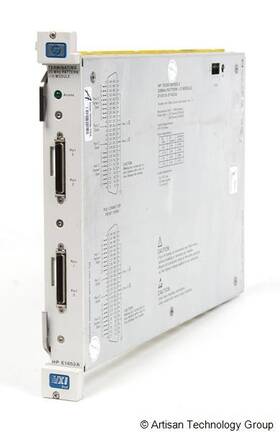
( Brand: Hp ), ( Manufacturer Part Number: E1452A ), ( Part Type: Module ), ( Country Of Origin: United States )
Review HP Terminating Mhz Pattern I/o Module
The **HP E1452A Terminating 20 I/O Module** is a high-performance, versatile input/output (I/O) expansion module designed to enhance the functionality of Hewlett Packard s Enterprise ProLiant server infrastructure, particularly within the context of its advanced management and connectivity solutions. This module serves as a critical component in HP s **Integrated Lights-Out (iLO) Advanced** and **iLO Standard** environments, enabling seamless integration with ProLiant servers to provide robust remote management, monitoring, and control capabilities. Engineered with precision, the E1452A is specifically tailored to support up to **20 discrete I/O channels**, allowing administrators to extend the reach of server management systems beyond the confines of a single chassis or rack. Its design emphasizes scalability, reliability, and ease of deployment, making it an indispensable asset for data centers, enterprise IT environments, and mission-critical infrastructure where remote oversight and automation are paramount.
Built upon HP s legacy of innovation in server management technology, the E1452A module incorporates a **low-profile, compact form factor** that ensures seamless compatibility with a wide range of ProLiant server models, including blade and rack-mounted systems. The module s **terminating functionality** allows it to act as a bridge between the server s baseboard management controller (BMC) and external I/O devices, such as sensors, relays, or other peripheral systems, facilitating real-time data acquisition and command execution. This capability is particularly valuable in scenarios requiring environmental monitoring such as temperature, humidity, or power supply status where proactive alerts and automated responses can prevent downtime and ensure operational continuity. The module s robust construction, featuring high-quality connectors and shielding, guarantees durability in demanding environments, while its compatibility with HP s **iLO firmware** ensures seamless integration with existing management frameworks.
One of the standout features of the E1452A is its **flexibility in I/O configuration**, allowing administrators to customize the module s functionality based on specific operational needs. Whether used for basic monitoring, advanced diagnostics, or automated system control, the module s **20-channel capacity** provides ample room for expansion, enabling the integration of additional sensors, actuators, or other I/O devices without compromising performance. This modularity is further enhanced by the module s support for **HP s I/O Expansion Framework**, which simplifies deployment and configuration through intuitive software tools. The E1452A also adheres to industry-standard protocols, ensuring interoperability with third-party systems where necessary, while its **low-power consumption** contributes to energy efficiency without sacrificing functionality.
Beyond its technical specifications, the HP E1452A Terminating 20 I/O Module represents a strategic investment in operational resilience and efficiency. By enabling remote management and automation, it reduces the need for on-site intervention, minimizes human error, and accelerates troubleshooting processes. This is particularly advantageous in large-scale deployments where managing multiple servers across distributed locations can be complex and resource-intensive. Whether deployed in a high-density data center, a cloud infrastructure, or a critical enterprise network, the E1452A module empowers IT teams to maintain greater control over their environments, enhance system reliability, and respond swiftly to potential issues. With its blend of advanced functionality, scalability, and seamless integration with HP s ecosystem, the E1452A stands as a cornerstone for modern server management, delivering both immediate operational benefits and long-term strategic value.
### **HP E1452A Terminating 20 I/O Module: Pros and Cons**
The **HP E1452A** is a terminating I/O module designed for use in HP ProLiant servers, particularly in blade systems like the **HP c-Class blades**. It provides 20 I/O ports (typically for Ethernet or Fibre Channel) and is used to terminate expansion slots in blade enclosures. Below is a detailed analysis of its advantages and disadvantages.
---
### **Pros**
1. **Compatibility with HP Blade Systems**
- The E1452A is specifically designed for HP ProLiant c-Class blade servers (e.g., c7000, c3000, c8000 enclosures). It ensures seamless integration with HP s blade infrastructure, reducing compatibility issues.
2. **Expansion and Termination Functionality**
- Serves as a **terminator** for expansion slots, preventing signal degradation in long blade enclosures. This is critical in large-scale blade deployments where signal integrity must be maintained.
- Allows for **additional I/O ports** (20) without requiring extra slots in the blade itself, optimizing resource usage.
3. **Reliability and Quality**
- HP modules are built to enterprise-grade standards, offering durability and low failure rates compared to third-party alternatives.
- Supports **hot-swappable** installation, minimizing downtime during maintenance.
4. **Scalability for Data Centers**
- Useful in environments requiring **high-density I/O**, such as virtualized data centers, cloud deployments, or high-performance computing clusters.
- Helps manage **network and storage traffic** by offloading some I/O requirements from the blades.
5. **Support for Multiple Protocols**
- While primarily used for **Ethernet (10/100/1000 Mbps)** or **Fibre Channel**, the module can be paired with compatible NICs or HBAs, making it versatile for different workloads.
6. **Long-Term Availability**
- As an older but well-supported HP part, it may still be available through authorized resellers or HP s support channels, though newer alternatives may exist.
---
### **Cons**
1. **Limited Modern Protocol Support**
- The E1452A is an older module (likely designed for **10Gb Ethernet or Fibre Channel**) and may not support **25G, 40G, or 100G** interfaces, which are increasingly common in modern data centers.
- Lack of **NVMe over Fabrics (NFV)** or **RDMA over Converged Ethernet (RoCE)** support, which are relevant for high-performance storage and AI/ML workloads.
2. **Obsolete in Newer Blade Systems**
- HP has transitioned to **Gen10/Gen11 blade servers** with updated I/O architectures. The E1452A may not be compatible with the latest blade enclosures (e.g., **Synergy, Moonshot, or newer c-Class models**).
- Requires **specific enclosure models** (e.g., older c7000/c3000), limiting flexibility in modern deployments.
3. **Potential for Higher Cost**
- Since it is a **terminating module**, it does not directly provide compute or storage resources but instead serves an infrastructure role. In some cases, newer alternatives (e.g., **HP FlexFabric adapters**) may offer better cost efficiency.
- Pricing may be higher than generic third-party terminating modules, though HP s reliability often justifies the cost.
4. **Limited Documentation and Support**
- As a legacy part, **HP s official support documentation** may be less detailed compared to newer components.
- Finding **authorized resellers** or **technical support** for this module may be more challenging than for current-gen HP parts.
5. **No Virtualization or Software Defined Networking (SDN) Features**
- Lacks integration with **HP s Virtual Connect** or **SDN controllers**, which are essential for modern network automation and orchestration.
- Cannot leverage **HP s Intelligent Provisioning** or **iLO Advanced** features for remote management.
6. **Physical Space and Power Considerations**
- Occupies a **slot in the blade enclosure**, which could otherwise be used for additional blades or other modules.
- While power consumption is minimal, every terminating module adds slight overhead to the enclosure s power budget.
---
### **Ending Conclusion**
The **HP E1452A Terminating 20 I/O Module** remains a **reliable and functional component** for maintaining signal integrity in **older HP blade enclosures (c7000, c3000)**. It excels in environments where **compatibility with legacy systems** is non-negotiable, and where **high-density I/O termination** is required without adding extra blades. However, its **lack of support for modern networking standards (25G , NVMeoF, SDN)** and **limited compatibility with newer HP blade architectures** make it less ideal for contemporary deployments.
For **new installations or upgrades**, HP now offers **more advanced I/O solutions** (e.g., **FlexFabric 10/25G adapters, Synergy-based networking, or third-party terminating modules**). If you are **maintaining an existing c-Class blade environment** and the E1452A is already in use, it can be a **cost-effective and stable choice**. Otherwise, evaluating **newer terminating modules or alternative architectures** may be more prudent.
---
### **Recommendation**
- **Use the HP E1452A if:**- You are **maintaining an existing c7000/c3000 blade enclosure** with no immediate upgrade plans.
- You require **20-port termination** for Ethernet/Fibre Channel in a legacy setup.
- You prioritize **HP s reliability and support** over cutting-edge features.
- **Avoid or Replace the HP E1452A if:**- You are **deploying a new blade environment** (consider **FlexFabric 10/25G adapters** or **Synergy-based networking**).
- Your workloads require **25G , NVMeoF, or SDN capabilities**.
- You are **migrating to newer HP blade systems** (e.g., c8000 Gen10 ) where alternative I/O solutions are available.
- You need **long-term scalability** with support for future networking standards.
For **long-term investments**, research **HP s current terminating modules** or **third-party alternatives** that support **modern protocols and virtualization features**. If budget allows, upgrading to a **more future-proof I/O architecture** will provide better performance and flexibility.
Details:
Are not included with this equipment unless pictured and/or listed in the above. Hours / Location. HP E1452A Terminating 20 MHz Pattern I/O Module:: This unit has the newer ejector handles. Fast and hassle-free.
part #: e1452a prices
- $110.97-$1950.00
specifications sensoindustria:
- brand: Hp
- mpn: E1452a
- part type: Module
- country of origin: United States
payments sensoindustria:
- wallet: Paypal
- other
- credit card: Diners-club
seller sensoindustria:
- rating: 99.9%
- city: Champaign, Illinois
- # reviews: 17626
general sensoindustria:
- condition: Used
- PLCs HMIs > PLC Peripheral Modules > PLC Input Output Modules
shipping sensoindustria:
- cost: $35.99
- service: FedEx Ground / FedEx Home Delivery, FedEx Standard Overnight, FedEx Ground Economy
- carrier: FedEx
- class: Standard, One-day, Economy
- type: Calculated
- transit: 4-7 Days
returns sensoindustria:
- policy: Returns Accepted
- method: Money back
- paid by: Buyer
- time: 30 Days
offer sensoindustria:
- sold: 0
- quantity: 6
- availability: In Stock
- options: Ship-to-home
- started: April 2, 2026
Hp E1452A Is Similar To:
- Hp Agilent E1485a Vxi Module Signal Processor 1fl0f5 1fl1fl1fl (31.2% similar) Hp agent E1485A xvi module signal processor 1FL0F5 1FL1FL1FL, : pulled from a good retired system. Shipping and handling, ups ground advantage rates are for contiguous states...(November 14th, 2024)
- Hp Agilent Z2472a 75000 Series C Arbitrary Waveform Generator Vxi Module (33.6% similar) Shipping and handling, ups ground advantage rates are for contiguous states...(November 15th, 2024)
- Hp Agilent E1430a 75000 Series C 10msa s Adc Filter Fifo Vxi Module (42.1% similar) Hp agent 75000 series c 10MSA/S ADC filter FIFO E1430A xvi module, : pulled from a good retired system. Shipping and handling, ups ground advantage rates are for contiguous states...(November 15th, 2024)
- Hp 83711-67001 Agilent Output Module For 83711x Etc Signal Generators Tested (25.8% similar) For 83711X, 83712X, 83732X. Hp agent key sight 83711-67001 output module...(December 26th, 2024)
- Hp M1072-66543 Video Input output Module (39.1% similar) Orders paid by 12 noon central time ship the same day. Hp video input/output module M1072-66543...(May 2nd, 2025)
- Hp Ca354-06310 Cbb Module T260369 (32.5% similar) Glad you stopped by. Hp CA354-06310 Cobb module T260369 brand:: Hp, condition: this is a used item, in good condition and includes 30 day warranty. Open to making bulk deals. Extra information. Rush orders ship same day. We proudly sell hard-to-find parts, components, and machines to makers ...(June 22nd, 2025)
- Hp Hvsc2 Ca356-00117 S i Bdu Module T260374 (35.6% similar) Glad you stopped by. Rush orders ship same day. Extra information. Reference NUMBER:T260374. Open to making bulk deals. Hp HVSC2 CA356-00117 s/i Bud module T260374 brand:: Hp, condition: this is a used item, in good condition and includes 30 day warranty. We proudly sell hard-to-find parts, ...(June 22nd, 2025)
- Hp Ca454-02996 Rfid Module Assy T261122 (32.6% similar) We proudly sell hard-to-find parts, components, and machines to makers manufacturers. Glad you stopped by. Open to making bulk deals. Rush orders ship same day. Hp CA454-02996 RFD module assay T261122 brand:: Hp, condition: this is a used item, in good condition and includes 30 day warranty. Extra ...(June 29th, 2025)
- Hp Ca454-04840 Module Assymbly T261284 (30.6% similar) Glad you stopped by. We proudly sell hard-to-find parts, components, and machines to makers manufacturers. Rush orders ship same day. Extra information:: bid HV2. Open to making bulk deals. Hp CA454-04840 module Assembly T261284 brand:: Hp, condition: this is a used item, in good condition and ...(July 15th, 2025)
- Hp Ca454-05480 Stpr2 Module Assymbly T261283 (35.2% similar) Hp CA454-05480 STPR2 module Assembly T261283 brand:: Hp, condition: this is a used item, in good condition and includes 30 day warranty. Glad you stopped by. Extra information:: for EC/3. We proudly sell hard-to-find parts, components, and machines to makers manufacturers. Open to making bulk deals...(July 15th, 2025)
- Agilent keysight 85081b Hp Input Module 100 Khz 1 Ghz (23.5% similar) Features: RF voltage and phase measurements made accurately simply. Hp - agent key sight 85081B input module 100 khz 1 GHz: item: make: agent/key sight. Model: 85081B. The agent 85081B is a high-impedance input module with frequency range of 100 khz to 1 GHz and included every standard 8508A ...(July 25th, 2025)
