BALLUFF BNI0072 Link Sensor Hub BNI007Z I/o BNI-IOL-302-002-K006
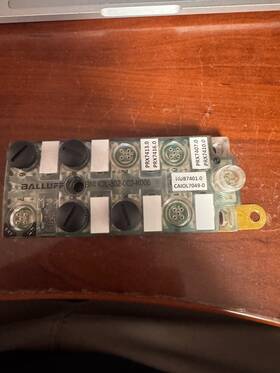
( Brand: Balluff ), ( Manufacturer Part Number: BNI0072 ), ( Part Type: Sensor Hub ), ( Country Of Origin: Germany )
Review BALLUFF I/o Link Sensor Hub
The **Balluff BNI0072 (BNI-IOL-302-002-K006)** is a high-performance **BNIolink Sensor Hub**, designed to streamline industrial automation by consolidating I/O connectivity, diagnostics, and communication into a single, compact device. Part of Balluff s advanced BNIolink series, this modular hub integrates seamlessly into modern factory environments, offering a robust solution for integrating a wide range of sensors, actuators, and field devices while reducing wiring complexity and enhancing system reliability. With its **302-series architecture**, the BNI0072 supports up to **12 digital I/O channels** (configurable as inputs or outputs) via its **K006 I/O module**, providing flexibility for discrete signaling applications such as machine monitoring, safety circuits, or process control. The hub s **Profinet, EtherNet/IP, and Modbus TCP** communication protocols ensure seamless integration with PLCs, SCADA systems, and enterprise networks, enabling real-time data exchange and remote diagnostics. Built to withstand harsh industrial conditions, the BNI0072 features **IP67 protection**, ensuring durability in environments exposed to dust, moisture, and temperature fluctuations, while its **compact, DIN-rail-mountable design** optimizes space utilization in control panels. Additionally, the device incorporates **Balluff s patented BNIolink technology**, which simplifies sensor integration by eliminating the need for separate I/O modules, reducing installation time and minimizing potential points of failure. Advanced diagnostic capabilities, including **real-time status monitoring, predictive maintenance alerts, and automatic error logging**, empower operators to proactively address issues, reduce downtime, and enhance overall equipment effectiveness (OEE). Whether deployed in discrete manufacturing, process automation, or packaging applications, the BNI0072 serves as a versatile backbone for smart factory initiatives, enabling efficient data-driven decision-making while maintaining high levels of operational efficiency and scalability.
### **Balluff BNI0072 / BNI007Z (I/O Link Sensor Hub) Pros and Cons**
#### **Overview**
The **Balluff BNI0072** and **BNI007Z** are I/O Link Sensor Hubs designed to simplify sensor integration in industrial automation. They act as a central hub for multiple sensors, converting analog or digital signals into a standardized I/O Link interface, which can then be connected to a PLC or other control systems. The **BNI-IOL-302-002-K006** appears to be a specific variant with 302 I/O Link ports and additional features.
---
### **Pros**
1. **Simplified Wiring and Installation**
- Reduces the number of individual sensor connections to the PLC by consolidating multiple sensors into a single hub.
- Eliminates the need for long, complex wiring runs, especially in large or distributed systems.
2. **Standardized Communication via I/O Link**
- Uses the **I/O Link** protocol, which is a robust, fieldbus-like communication standard optimized for industrial sensors.
- Provides deterministic communication with low latency, ensuring reliable data transfer.
3. **Scalability and Flexibility**
- Supports a wide range of sensors (proximity, pressure, temperature, etc.) via compatible I/O Link sensors.
- Can be easily expanded with additional hubs or modules if more I/O capacity is needed.
4. **Reduced PLC Load**
- Offloads sensor data processing from the PLC, allowing the PLC to focus on higher-level control tasks.
- Some models include built-in diagnostics and filtering, reducing noise and false signals.
5. **Diagnostic and Monitoring Capabilities**
- Many Balluff I/O Link hubs provide **diagnostic data** (e.g., sensor status, signal quality, fault codes) that can be read via the I/O Link interface.
- Enables predictive maintenance by monitoring sensor health remotely.
6. **Compatibility with Balluff and Third-Party Sensors**
- Works seamlessly with **Balluff I/O Link sensors**, but some variants may also support third-party sensors with proper configuration.
- Integrates well with **Siemens, Allen-Bradley, and other PLC brands** that support I/O Link.
7. **Reduced Cable Clutter**
- Replaces multiple sensor cables with a single I/O Link cable (or bus) connecting the hub to the PLC, improving cable management.
8. **Future-Proofing**
- I/O Link is a well-established standard with ongoing support, ensuring long-term compatibility with new sensors and control systems.
9. **Cost-Effective for Large Installations**
- While the initial cost of the hub may be higher than individual sensor connections, the long-term savings in wiring, installation, and maintenance can be significant.
10. **Easy Integration with Balluff s Software Tools**
- Compatible with **Balluff s configuration software** (e.g., **Balluff Configurator**), which simplifies setup and troubleshooting.
---
### **Cons**
1. **Higher Upfront Cost**
- The initial purchase price of the I/O Link hub (especially high-port models like the BNI-IOL-302) is higher than connecting individual sensors directly to a PLC.
- May not be cost-effective for small or simple installations with few sensors.
2. **Dependency on I/O Link Ecosystem**
- Requires **I/O Link-compatible sensors**, which may limit flexibility if only non-I/O Link sensors are available.
- Some third-party sensors may not integrate seamlessly without additional adapters or converters.
3. **Learning Curve for Setup and Configuration**
- Configuring the hub and sensors requires familiarity with **I/O Link protocols** and Balluff s software tools.
- Misconfiguration can lead to communication errors or undetected sensor failures.
4. **Single Point of Failure Risk**
- If the hub fails, all connected sensors may go offline, potentially disrupting production.
- Requires redundancy planning (e.g., backup hubs) in critical applications.
5. **Limited Physical Expansion**
- While I/O Link supports daisy-chaining, excessive length or poor cabling can degrade signal integrity.
- Some models may have **physical size limitations**, making installation tricky in space-constrained environments.
6. **Vendor Lock-In Potential**
- Heavy reliance on **Balluff s I/O Link ecosystem** may make it harder to switch to alternative sensor brands or communication protocols later.
- Some advanced features may require proprietary Balluff tools.
7. **Maintenance and Troubleshooting Complexity**
- Diagnosing issues (e.g., sensor failures, communication errors) can be more complex than with direct PLC connections.
- Requires access to diagnostic software and training for effective troubleshooting.
8. **Not Ideal for High-Speed or High-Precision Applications**
- While I/O Link is fast, it may not match the **sub-microsecond latency** of some high-speed digital I/O solutions.
- For ultra-high-precision applications, direct analog or digital connections may still be preferred.
9. **Compatibility Issues with Older PLCs**
- Some older PLC models may require **additional modules or drivers** to support I/O Link, adding complexity and cost.
10. **Limited Global Availability of I/O Link**
- While I/O Link is widely used in Europe and some Asian markets, it may be less common in regions where **Profibus, Ethernet/IP, or Modbus** dominate.
- Availability of I/O Link sensors and hubs may vary by region.
---
### **Conclusion**
The **Balluff BNI0072 / BNI007Z I/O Link Sensor Hubs** are **excellent for large-scale industrial applications** where **simplified wiring, reduced PLC load, and standardized communication** are priorities. They excel in **manufacturing, packaging, and process automation** where multiple sensors need to be integrated efficiently.
However, they may **not be justified for small installations, non-I/O Link sensor environments, or applications requiring ultra-high-speed or ultra-precise I/O**. The **upfront cost, learning curve, and dependency on Balluff s ecosystem** are significant drawbacks for some users.
For **new projects with a high number of sensors, long-term cost savings, and ease of maintenance**, the BNI0072/BNI007Z is a **strong recommendation**. For **small-scale or highly specialized applications**, a direct PLC connection or a different communication protocol (e.g., Profibus, Ethernet/IP) may be more appropriate.
---
### **Final Recommendation**
**Buy the Balluff BNI0072/BNI007Z if:**You are integrating **30 sensors** in a single system.
You prioritize **simplified wiring, reduced PLC load, and standardized communication**.
Your application uses **Balluff or I/O Link-compatible sensors**.
You have **long-term maintenance and scalability** in mind.
Your PLC supports **I/O Link** (or you are willing to add the necessary interface).
**Avoid the BNI0072/BNI007Z if:**Your installation is **small-scale** (fewer than 10 sensors).
You are working with **non-I/O Link sensors** without conversion options.
You require **ultra-high-speed or ultra-precise I/O** that direct connections provide.
Your budget is **constrained**, and the upfront cost is prohibitive.
Your team lacks **experience with I/O Link configuration**.
**Alternative Considerations:**- For **smaller setups**, consider **direct PLC connections** or **digital I/O modules**.
- For **mixed sensor environments**, evaluate **Profibus, Ethernet/IP, or Modbus** alternatives.
- If **redundancy is critical**, pair the hub with a **backup solution** (e.g., dual hubs).
Details:
BNI-IOL-302-002-K006, BUYER PAYS THE SHIPPING. LOT 4601, USED - BALLUFF I/O LINK SENSOR HUB, PART NO. BNI007Z, PART NO.
part #: bni0072 prices
- $98.00-$119.00
specifications sensoindustria:
- brand: Balluff
- mpn: Bni0072
- part type: Sensor Hub
- country of origin: Germany
shipping sensoindustria:
returns sensoindustria:
- policy: No Returns
seller sensoindustria:
- city: Imlay City, Michigan
- # reviews: 930
- rating: 100.0%
general sensoindustria:
- PLCs HMIs > PLC Peripheral Modules > PLC Input Output Modules
- condition: Used
payments sensoindustria:
- wallet: Paypal
- credit card: Visa
- other
offer sensoindustria:
- sold: 0
- best offers: True
- started: March 26, 2026
- options: Ship-to-home
- availability: In Stock
- quantity: 1
Balluff BNI0072 Is Similar To:
- 18kf-pa-1-loc-s4-c Balluff Photielectric Sensor Bos (34.8% similar) Balluff sensor BIOS 18K-PA-LOC-S4-C S2...(March 7th, 2017)
- Sensor Photoelectric Bfs 26k-ps-l01-s115 Balluff 12-28vdc (18.2% similar) New but don't have box or paperwork...(May 11th, 2015)
- 24vdc Bes Proximity 153603 515-362-s4c Sensor Balluff Box (16.3% similar) Austin surplus location Greg R18 P18 S05 b thread. Item is new, unused, no factory packaging new no box, Balluff Be's S4C proximity sensor, 24VDC, M30 x...(June 11th, 2015)
- Package Sensor Proximity Open 516-370-e5--s4 Bes Balluff (26.2% similar) I will reply as soon as possible. I will communicate with you throughout the buying process. You are buying on a new sensor by Balluff. Thanks and happy buying. I am also an buyer and I want to treat you as I like to be treated...(May 25th, 2015)
- 517-399-no-03 Inductive Balluff Box Sensor 03 5 517-399 Total Bes (32.6% similar) Total of 5 in the box all are new box is dusty and opened but all the sensors are new...(September 25th, 2015)
- 66m-la04-s92 Balluff Mont Distance Custom 2 Bod Photoelectric Steel Sensor (33.1% similar) ...(May 14th, 2015)
- 010-psb-1-l-pu-02 Balluff Bcs Pnp 12-35v-dc 200ma Sensor D509892 (34.4% similar) Balluff BC's 010 PBS 1 l Pu 02 NP 12 35V dc 200MA sensor D509892...(June 11th, 2016)
- 030-ns-1-c-03 Balluff Capacitive Sensor Bcs (35.5% similar) Brand new item without original packaging. Ships USPS expedited for free...(November 29th, 2015)
- Arp00046349 Rpta-3005-pu-01 Balluff Inductive Sensor 12vdc (31.1% similar) Part #: 12VDC prices...(February 14th, 2016)
- 18k-1-c30-20-02 Balluff Sensor Laer Bos Bos01ae Photoelectric (30.4% similar) ...(September 6th, 2015)
- 18m-pa-ld10-s4 Balluff Bos Photoelectric Sensor 10-30vdc 100ma (39.7% similar) Item comes with connector and mounting bracket. Balluff BIOS 18M pa LD10 s4 photoelectric sensor 10 30VDC 100MA. I have have listed it as used, however, it was never installed...(January 2nd, 2016)
