BECKHOFF BK5100 Canopen Bus Coupler
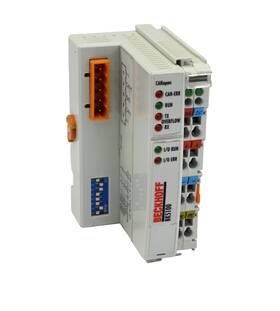
( Brand: Beckhoff ), ( Manufacturer Part Number: BK5100 ), ( Type: Automation Module ), ( Unit Type: Unit ), ( Analog/digital: Analog ), ( Country Of Origin: Germany )
Review BECKHOFF Canopen Compact Bus Coupler
The **Beckhoff BK5100 CANopen Bus Coupler** is a high-performance, modular industrial communication interface designed to seamlessly integrate CANopen networks into modern automation systems, bridging the gap between field devices and higher-level control architectures. Engineered with Beckhoff s signature precision and reliability, this compact yet robust coupler serves as a versatile gateway for connecting a wide range of CANopen-compatible sensors, actuators, and controllers while ensuring deterministic data exchange and minimal latency. Built on the foundation of Beckhoff s TwinCAT automation software ecosystem, the BK5100 leverages the power of CANopen s standardized communication protocol (CIA 301) to facilitate real-time synchronization, cyclic data transfer, and event-driven messaging, making it an ideal solution for applications requiring high-speed, low-jitter communication. Its rugged, industrial-grade construction ensures resilience against harsh environmental conditions, including temperature fluctuations, electrical noise, and mechanical stress, while its compact form factor allows for flexible integration into existing control cabinets or distributed automation setups.
At the heart of the BK5100 is its dual-port CANopen interface, which supports both standard (1 Mbps) and high-speed (5 Mbps) communication modes, accommodating a broad spectrum of industrial applications from simple sensor monitoring to complex motion control systems. The coupler s built-in diagnostic capabilities provide real-time monitoring of network health, including error counters, signal integrity checks, and automatic fault detection, enabling proactive maintenance and minimizing downtime. Additionally, the BK5100 features a user-friendly configuration interface, accessible via TwinCAT or Beckhoff s XFC (eXtended Functionality Controller) software, allowing engineers to effortlessly define device profiles, parameterize communication cycles, and optimize data handling for specific application requirements. Whether deployed in discrete manufacturing, process automation, or robotics, the BK5100 ensures seamless interoperability with other Beckhoff components, such as TwinCAT PLCs, I/O modules, and motion controllers, while also supporting third-party CANopen devices through its compliance with international standards like IEC 61158 and IEC 61784.
Beyond its technical capabilities, the BK5100 embodies Beckhoff s commitment to scalability and future-proofing, offering backward and forward compatibility with evolving CANopen specifications. Its modular design allows for easy expansion, enabling the integration of additional CANopen networks or the connection of multiple bus segments without compromising performance. The coupler s deterministic communication ensures predictable timing, which is critical for applications requiring synchronized motion control, such as CNC machines, packaging systems, or automated assembly lines. Furthermore, the BK5100 s integration with Beckhoff s TwinCAT software ecosystem enables advanced features like cyclic synchronous communication (Cyclic Synchronization), which synchronizes multiple axes or devices with microsecond precision, further enhancing the efficiency and coordination of distributed automation systems. With its blend of cutting-edge technology, industrial durability, and seamless integration capabilities, the Beckhoff BK5100 CANopen Bus Coupler stands as a cornerstone for modern, high-performance industrial communication solutions.
### **Pros and Cons of buying a Beckhoff BK5100 CANopen Bus Coupler**
#### **Pros**
1. **High Reliability and Performance** The BK5100 is designed for industrial automation, offering robust communication with minimal latency. Beckhoff s reputation for high-quality hardware ensures long-term stability in demanding environments.
2. **CANopen Compatibility** As a CANopen bus coupler, it integrates seamlessly with Beckhoff s TwinCAT system and other CANopen-compatible devices, enabling efficient data exchange in motion control, PLC, and I/O applications.
3. **Compact and Modular Design** The small form factor allows for easy integration into existing control systems without requiring significant space adjustments. It can be mounted on a DIN rail or in a terminal block.
4. **Low Latency and High Bandwidth** CANopen supports real-time communication, making it ideal for applications requiring precise timing, such as robotics, CNC machines, or automated manufacturing lines.
5. **Compatibility with TwinCAT** If you re already using Beckhoff s TwinCAT software, the BK5100 provides a straightforward way to extend CANopen connectivity without additional middleware, simplifying programming and debugging.
6. **Easy Configuration via TwinCAT** The device can be configured and monitored directly through TwinCAT s engineering environment, reducing the need for external tools.
7. **Support for Multiple Communication Modes** It supports both CANopen (DS-301) and CANopen (DS-401) profiles, offering flexibility in device integration.
8. **Good Documentation and Support** Beckhoff provides comprehensive technical documentation, including data sheets, programming examples, and customer support, which helps in troubleshooting and implementation.
---
#### **Cons**
1. **Cost** Compared to generic CAN transceivers or simpler bus couplers, the BK5100 is a premium product, which may be an investment for smaller projects or budget-conscious buyers.
2. **Vendor Lock-In** While Beckhoff s ecosystem is robust, relying on TwinCAT and Beckhoff-specific tools may limit flexibility if you need to integrate with non-Beckhoff systems in the future.
3. **Learning Curve for CANopen** If your team is unfamiliar with CANopen protocols, there may be an initial learning curve in configuring and troubleshooting the device.
4. **Limited Physical Connectivity Options** The BK5100 typically uses standard CAN connectors (e.g., 9-pin D-sub or M12), which may require additional adapters or cabling for certain setups.
5. **No Built-in Isolation (Standard Model)** The basic BK5100 does not include galvanic isolation, which may require additional components (e.g., Beckhoff s BK5000 series) if your application demands noise immunity or safety isolation.
6. **Dependence on TwinCAT for Full Functionality** While the device works independently, its full potential is realized when used with TwinCAT, which may not be ideal for users without a Beckhoff automation setup.
---
### **Conclusion**
The **Beckhoff BK5100 CANopen Bus Coupler** is an excellent choice for industrial automation applications requiring reliable, high-speed CANopen communication, particularly when integrated with Beckhoff s TwinCAT system. Its strengths lie in performance, ease of use within the Beckhoff ecosystem, and compatibility with real-time control systems. However, its higher cost and potential vendor lock-in may be drawbacks for users with limited budgets or diverse system requirements.
If your project involves **Beckhoff-based automation, motion control, or PLC integration with CANopen devices**, the BK5100 is a strong recommendation due to its seamless integration and reliability. For **non-Beckhoff systems or cost-sensitive applications**, a generic CANopen transceiver or a simpler bus coupler might be more appropriate.
### **Recommendation**
- **Buy the BK5100 if:**- You are already using Beckhoff s TwinCAT or other Beckhoff hardware.
- Your application demands high-speed, low-latency CANopen communication.
- You prioritize long-term reliability and support from a trusted automation vendor.
- **Consider alternatives if:**- You need a lower-cost solution and are not tied to Beckhoff s ecosystem.
- Your system requires additional features like galvanic isolation (in which case the BK5000 series may be better).
- Your team lacks experience with CANopen protocols, and simpler interfaces would be preferable.
Details:
Part # BK5100. FOR UP TO 64 BUS TERMINALS. Weight 0.47 lbs.
part #: bk5100 prices
- $100.00-$119.00
specifications sensoindustria:
- brand: Beckhoff
- mpn: Bk5100
- type: Automation Module
- unit type: Unit
- analog/digital: Analog
- country of origin: Germany
shipping sensoindustria:
- cost: $9.00
- transit: 3-7 Days
- class: Economy, Standard, One-day
- type: Fixed
- service: FedEx Ground Economy, UPS Ground, UPS Next Day Air
- carrier: FedEx, UPS
general sensoindustria:
- PLCs HMIs > PLC Peripheral Modules > PLC Input Output Modules
- condition: Used
payments sensoindustria:
- credit card: Diners-club
- wallet: Apple-pay
- other
returns sensoindustria:
- paid by: Buyer
- policy: Returns Accepted
- time: 30 Days
- method: Money back
offer sensoindustria:
- options: Ship-to-home
- started: June 3, 2026
- availability: In Stock
- quantity: 1
- sold: 0
seller sensoindustria:
- rating: 100.0%
- # reviews: 4488
- city: Kennesaw, Georgia
Beckhoff BK5100 Is Similar To:
- Bk2000 Beckhoff Lkightbus Bus Coupler (57.5% similar) No means to test. All statements regarding products and their configurations are made to the best of our ability with assumption that buyer is knowledgeable proficient in use this type equipment. No manuals,no standard power cords, even if it appears in the photo, accessories, software etc are ...(December 28th, 2017)
- Fc5101-0000 Beckhoff Canopen Mstr Pc (48.1% similar) ...(October 2nd, 2017)
- Kl9210 Kl9010 Beckhoff Bus End Terminal And Voltage Supply (29.7% similar) A Beckhoff KL9010 bus end terminal and KL9210 voltage supply with fuse diagnostics item details this listing is for used cards. Posted the android app. Br a s: pages. It is a used tested module that guaranteed working...(April 29th, 2018)
- Beckhoff Bk3120 Profibus Coupler (66.7% similar) Beckhoff BK3120 profits coupler. This coupler is used but in excellent condition. This listing is for 1 Beckhoff profits coupler, model BK3120...(February 3rd, 2024)
- Beckhoff Kl1304 Bus Terminal 4-channel Digital Input 24 V Dc 3 Ms Type 2 Goa (30.3% similar) Quality guarantee. Free shipping. Items are not returnable for condition issues commented on or shown in the pictures. Fast dispatch service. If you ever have any questions or are unsatisfied, for reason please let us know. Quick delivery. Vb industrial supply offers a huge selection of tools for ...(September 13th, 2024)
- Beckhoff Ks4002 Bus Terminal 2-channel Analog Output 0-10v 12bit (33.6% similar) Vb industrial supply takes great pride to honestly and accurately describe each item listed. Fast dispatch service. Items are not returnable for condition issues commented on or shown in the pictures. Free shipping. Quality guarantee. Vb industrial supply offers a huge selection of tools for every ...(September 18th, 2024)
- Beckhoff Ks2612 Bus Terminal 2-channel Relay Output 125 V Ac 30 Dc 0.5 A 2 (29.1% similar) If you ever have any questions or are unsatisfied, for reason please let us know. Quick delivery. Fast dispatch service. Quality guarantee. Free shipping. Items are not returnable for condition issues commented on or shown in the pictures. Title: Beckhoff KS2612 bus terminal 2-CHANNEL relay output ...(September 19th, 2024)
- Beckhoff Kl6211 Bus Terminal 1-channel Communication Interface 4409 (30.9% similar) Manufacturer part number: KL6211. Used - attached: Beckhoff KL9528 and unknown part. Beckhoff KL6211 bus terminal, 1-CHANNEL communication interface. Special instructions. Beckhoff KL6211 bus terminal, 1-CHANNEL communication interface manufactured by Beckhoff...(October 14th, 2024)
- Beckhoff Bk7520 Sercos Coupler With Ks Extensions (54.3% similar) Beckhoff BK7520 servos coupler. Free shipping us only...(November 11th, 2024)
- Beckhoff Kl2794 Bus Terminal 4-channel Solid State Relay Output Free Shipping (26.7% similar) Beckhoff KL2794 bus terminal, 4-CHANNEL solid state relay output. Working pull from fully functional machine. Used in good working condition. 60 day warranty included. Free shipping in the continental us...(November 20th, 2024)
- Beckhoff Ek1541 Ethercat Pof Coupler (60.8% similar) System integration: the EK1541 enables flexible network topology with unique id assignment capabilities. A station consists of a coupler and any number ether cat terminals that are automatically detected individually displayed in the process image. Power specifications: system and field supply: 24V ...(November 24th, 2024)
