SIEMENS 6ES7677-1DD40-1AA0 Simatic Em Expansion Module PCI-104
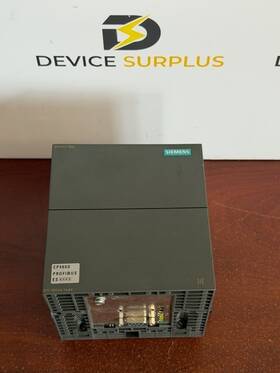
( Brand: Siemens ), ( Manufacturer Part Number: 6ES7677-1DD40-1AA0 ), ( Part Type: Module ), ( Country Of Origin: Germany )
Review SIEMENS Simatic S7 Em Pci-104 Expansion Module
The **Siemens 6ES7677-1DD40-1AA0 SIMATIC S7-300 PCI-104 Expansion Module** is a high-performance, modular interface designed to seamlessly integrate with the SIMATIC S7-300 programmable logic controller (PLC) system, offering robust expansion capabilities for industrial automation applications. This compact yet versatile module adheres to the **PCI-104** standard, ensuring compatibility with a wide range of third-party and Siemens-compatible devices, making it an ideal solution for systems requiring additional I/O, communication interfaces, or specialized processing power. Built with Siemens signature reliability and precision engineering, the module features a **16-bit data bus** and **32-bit address space**, enabling efficient data transfer between the host PLC and peripheral devices while maintaining low latency critical for real-time control applications. Its **104-pin connector** follows the industry-standard PCI-104 form factor, allowing for easy integration into backplane systems, enabling vertical stacking or side-by-side mounting in industrial enclosures. The module supports **SIMATIC NET** protocols, including **PROFIBUS DP, MPI, and Ethernet (via optional add-ons)**, ensuring seamless communication with other Siemens controllers, HMIs, or field devices. Whether deployed for **motion control, high-speed data acquisition, or as a bridge to external processors**, this expansion module enhances system flexibility without compromising performance. Its rugged construction, with **industrial-grade components and robust shielding**, ensures durability in harsh environments, making it suitable for applications in manufacturing, process automation, or energy management. Engineers and technicians will appreciate its **easy integration with TIA Portal**, Siemens unified engineering framework, which simplifies programming, diagnostics, and troubleshooting through intuitive tools like **S7-PLCSIM** for offline simulation. With its **backward and forward compatibility** across Siemens S7-300 series, this module serves as a future-proof investment, allowing system upgrades or expansions without requiring a complete hardware overhaul. Whether used as a standalone expansion card or as part of a larger distributed control architecture, the **6ES7677-1DD40-1AA0** delivers the performance, reliability, and adaptability demanded by modern industrial automation demands.
The Siemens **6ES7677-1DD40-1AA0** is a **SIMATIC S7-300/400 EM PCI-104 expansion module**, designed to extend the functionality of a PLC system by adding Ethernet communication capabilities. Below is a detailed breakdown of its pros and cons, followed by a conclusion and recommendation.
---
### **Pros**
1. **Ethernet Communication**
The module provides **Ethernet connectivity (10/100 Mbps)** for direct integration with industrial networks (e.g., PROFINET, TCP/IP, OPC UA). This enables remote monitoring, data exchange, and communication with higher-level systems like SCADA or MES platforms.
2. **Compatibility with S7-300/400**
It is designed to work seamlessly with **SIMATIC S7-300 and S7-400** CPUs, expanding their capabilities without requiring a full system upgrade. This makes it a cost-effective solution for adding networking features to existing installations.
3. **Modular and Scalable**
The PCI-104 form factor allows for easy integration into **industrial PCs or other compatible systems**, enabling flexible architecture. It can be used in distributed control applications where additional communication ports are needed.
4. **Reliable Industrial Design**
Siemens modules are built for harsh industrial environments, with features like **wide operating temperature ranges (-40 C to 60 C)**, robust shielding, and compliance with industrial standards (e.g., EN 61131-2). This ensures long-term reliability in factory settings.
5. **Support for Multiple Protocols**
While primarily an Ethernet module, it can be configured for various communication protocols (e.g., **TCP/IP, UDP, MODBUS TCP**), making it versatile for different automation needs.
6. **Backward and Forward Compatibility**
The module supports **SIMATIC NET and TIA Portal**, ensuring compatibility with older Siemens systems while also working with newer software environments.
7. **Reduced Wiring Complexity**
By offloading communication tasks to the module, it reduces the load on the main CPU, allowing for more efficient use of processing resources.
---
### **Cons**
1. **Limited to Ethernet Only**
Unlike some expansion modules that support multiple communication types (e.g., PROFIBUS, CAN), this module is **exclusively Ethernet-based**. If other protocols are required, additional modules would be needed.
2. **Deprecated Software Support**
Siemens has **phased out support for some older S7-300/400 versions** in newer TIA Portal releases. While the hardware may still function, firmware updates or full compatibility with the latest Siemens software may be limited.
3. **Potential Obsolescence**
The **S7-300/400 series is being replaced by newer platforms** (e.g., S7-1200, S7-1500, ET 200SP). While this module will continue to work, future-proofing may require migrating to more modern solutions.
4. **Single-Port Limitation**
The module provides **only one Ethernet port**, which may be insufficient for high-bandwidth applications or redundant network setups. Additional modules or switches may be required.
5. **Cost of Replacement Parts**
As Siemens transitions to newer technologies, **spare parts and technical support for older modules** may become harder to obtain over time, increasing long-term maintenance costs.
6. **No Built-in Security Features**
While Ethernet modules are generally secure, this specific module lacks **advanced security features** (e.g., VPN, firewall integration) that are available in newer Siemens communication modules.
7. **Dependence on Siemens Ecosystem**
If the system relies heavily on **third-party devices or non-Siemens protocols**, integration may require additional gateways or converters, adding complexity.
---
### **Conclusion**
The **Siemens 6ES7677-1DD40-1AA0** is a **practical and reliable choice** for extending Ethernet communication in **S7-300/400 systems**, particularly in applications where direct network connectivity is essential. Its **industrial robustness, modular design, and compatibility with legacy systems** make it a solid option for existing installations.
However, its **lack of support for newer Siemens platforms, limited protocol options, and potential obsolescence risks** should be carefully considered. If the system is **not planned for long-term use or upgrade**, this module provides excellent value. For **new projects or future-proofing**, newer Siemens communication modules (e.g., **S7-1500 CPUs with integrated Ethernet**) or **alternative vendors** (e.g., Beckhoff, Allen-Bradley) may be more suitable.
---
### **Recommendation**
- **Buy if:**- You are maintaining an **existing S7-300/400 system** and need Ethernet expansion.
- The application does not require advanced protocols beyond TCP/IP.
- Budget constraints make newer modules impractical.
- The module will be used in a **stable, long-term environment** where obsolescence is not a concern.
- **Avoid if:**- You are planning to **upgrade to newer Siemens PLCs** (S7-1200/1500) in the near future.
- The application requires **multiple communication protocols** (e.g., PROFIBUS, CAN).
- You need **redundant network connections** or advanced security features.
- You are working on a **new project** where future-proofing is a priority.
- **Alternatives to Consider:**- For **new projects**, evaluate **S7-1500 CPUs with integrated Ethernet** or **Beckhoff EtherCAT modules**.
- If **PROFIBUS or other industrial protocols** are needed, consider **S7-300/400 CPUs with built-in communication modules** (e.g., 6ES7 391-1AH00-0AB0).
- For **high-speed data acquisition**, look into **SIMATIC ET 200SP or TwinCAT-based systems**.
In summary, this module is a **good short-to-medium-term solution** for Ethernet expansion in S7-300/400 systems but may not be the best long-term investment for evolving automation needs.
Details:
part #: 6es76771dd401aa0 prices
- $164.70-$706.56
specifications sensoindustria:
- brand: Siemens
- mpn: 6es7677-1dd40-1aa0
- part type: Module
- country of origin: Germany
offer sensoindustria:
- sold: 0
- availability: In Stock
- started: February 13, 2026
- best offers: True
- quantity: 1
- options: Ship-to-home
shipping sensoindustria:
- cost: $12.00
- service: Standard
- transit: 4-6 Days
- type: Fixed
- class: Standard
payments sensoindustria:
- wallet: Paypal
- other
- credit card: Diners-club
- money order
returns sensoindustria:
- time: 60 Days
- policy: Returns Accepted
- method: Money back
- paid by: Buyer
general sensoindustria:
- PLCs HMIs > PLC Peripheral Modules > PLC Input Output Modules
- condition: Used
seller sensoindustria:
- city: Menasha, Wisconsin
- # reviews: 2466
- rating: 100.0%
Siemens 6ES7677-1DD40-1AA0 Is Similar To:
- 132-4hb01-0ab0 Siemens Digital Output Module (33% similar) Digital output module 6ES7132-4HB01-0AB0...(December 24th, 2017)
- 214-1ad22-0xb0 Siemens Simatic S7-200 Power (40.7% similar) Please e-mail with any questions. This item is guaranteed to be as described...(February 24th, 2018)
- 222-1bf22-0xa0 Siemens Used Output Module Make Offer (34.2% similar) All technical questions problems should be addressed through messages for the fastest possible service. Any damaged package received should be addressed with the delivering USPS office and a claim filed there. This lot consists of: 1 used Siemens 6ES7 222-1BF22-0XA0 output module no box condition: ...(March 7th, 2019)
- 235-0kd20-0xa0 Siemens Analog Expansion Module (46.8% similar) Siemens 6ES7 235-0KD20-0XA0 EM235 analog I o expansion module in good used condition, recently removed from a working installation. Sold as pictured. No manual, cables or other accessories included...(April 21st, 2018)
- 235-0kd21-0xa0 Siemens Analog Expansion Module (46.8% similar) No manual, cables or other accessories included. Sold as pictured. Siemens 6ES7 235-0KD21-0XA0 EM235 analog I o expansion module in good used condition, recently removed from a working installation...(April 21st, 2018)
- 2586234-0001 Siemens New Sealed Digital Output Module (37.3% similar) This part is newly sealed inside its oem box. All parts repair items sold are final sales. A 30-DAY warranty included...(October 1st, 2018)
- 2586234-0002 Siemens Module Digital Output Dc New In Box Nib (22.4% similar) Only 235 with free shipping anywhere in north America. For regions other than north America, please a shipping quote. You are buying the best of for a fraction cost. The in very good condition all as visible pictures. Siemens module digital output 2a dc new in box nib with free shipping is old stock...(November 10th, 2018)
- 25862410-0001 Siemens New Relay Output Module (36.4% similar) A 30-DAY warranty included. All parts repair items sold are final sales. This part is newly sealed inside its oem box...(October 1st, 2018)
- 321-1bh02-0aa0 Siemens Simatic S7 I-o (41.2% similar) Siemens simatic s7 I o module 1p 6ES7 321-1BH02-0AA0 w connector 392-1AJ00-0AA0 this item is posted and managed courtesy of bonanza...(September 14th, 2017)
- 3ra1921-1ba00 Siemens New Factory Sealed Module Dc 4011209516496 (31% similar) 3RA1921-1BA00 Siemens new factory sealed 3RA19211BA00 dc link module for size s0 as shown item location 11D...(June 29th, 2018)
- 3rk1100-1cq00-0aa3 Siemens Electronic Module (34.9% similar) ...(March 8th, 2018)
