SCHNEIDER ELECTRIC 30-3001-812 Andover Continuum Analog Plc Input/output Module
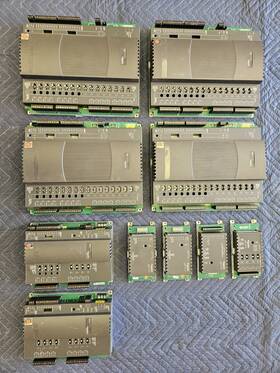
( Brand: Schneider Electric ), ( Manufacturer Part Number: 30-3001-812 ), ( Type: Plc Input/output Module ), ( Analog/digital: Analog ), ( Controller Platform: Bacnet )
Review SCHNEIDER ELECTRIC Andover Continuum Analog Plc Input/output Module
The **Schneider Electric Andover Continuum 30-3001-812 Analog I/O Module** is a high-performance, modular component designed to integrate seamlessly into the Andover Continuum platform, a robust industrial automation solution tailored for building management systems, process control, and distributed automation applications. This versatile **16-channel analog input/output module** combines precision engineering with flexible configuration to deliver reliable signal processing for a wide range of industrial and commercial environments. Engineered with Schneider Electric s commitment to scalability and interoperability, the 30-3001-812 supports both **analog voltage (0 10V, 10V, 0 20mA, 4 20mA)** and **analog current inputs/outputs**, making it an ideal choice for applications requiring seamless interfacing with sensors, actuators, and field devices. Its **16-channel architecture** allows for efficient monitoring and control of temperature, pressure, flow, humidity, and other analog signals, while its **isolated inputs and outputs** ensure protection against electrical noise and voltage spikes, enhancing system reliability in demanding industrial settings.
Built to operate within the Andover Continuum s modular framework, this module leverages Schneider Electric s **EcoStruxure architecture**, enabling seamless integration with other Continuum components such as controllers, gateways, and software platforms like **EcoStruxure Building Operation (EBO)** or **EcoStruxure Resource Advisor**. The 30-3001-812 features **high-resolution analog-to-digital conversion (16-bit resolution)** for precise signal acquisition, ensuring accurate data representation for critical control applications. Its **backplane-powered design** eliminates the need for external power supplies, simplifying installation and reducing system complexity. Additionally, the module supports **hot-swappable functionality**, allowing for maintenance or upgrades without disrupting ongoing operations, a feature that significantly enhances system uptime and operational efficiency.
Designed with **industrial durability in mind**, the 30-3001-812 operates within a temperature range of **-40 C to 70 C**, making it suitable for harsh environments such as manufacturing plants, data centers, and outdoor installations. Its **compact, DIN-rail mountable form factor** optimizes space utilization in control panels and enclosures, while its **compliance with international standards** including **IEC 61131-2, UL 508, and CE certification** ensures adherence to global safety and performance regulations. The module s **configurable parameters** via the Andover Continuum s **EcoStruxure Configuration Tool** allow engineers to tailor settings for specific applications, including **scaling, filtering, and alarm thresholds**, further enhancing its adaptability. Whether deployed in a **building automation system (BAS) for HVAC control**, a **process automation setup for chemical manufacturing**, or a **distributed control system (DCS) for industrial machinery**, the 30-3001-812 delivers **uncompromising performance, reliability, and integration flexibility**, making it a cornerstone of modern industrial automation infrastructures.
### **Pros and Cons of buying a Schneider Electric Andover Continuum Analog I/O Module (30-3001-812)**
#### **Overview**
The **Schneider Electric Andover Continuum 30-3001-812** is an analog input/output module designed for industrial automation, particularly for use with the **Continuum PLC platform**. It supports **analog voltage/current inputs and outputs**, making it suitable for applications requiring precise control of processes like temperature, pressure, flow, or motor speed.
---
### **Pros**
1. **Compatibility with Schneider Ecosystem**
- Seamlessly integrates with **Schneider Electric s Continuum PLCs**, EcoStruxure architecture, and other industrial automation systems.
- Supports **Modbus, OPC UA, and other communication protocols**, ensuring interoperability with SCADA, HMI, and enterprise systems.
2. **High Precision and Reliability**
- Designed for **industrial environments**, offering robust performance in harsh conditions (temperature, vibration, electrical noise).
- **High-resolution analog conversion** (typically 16-bit or higher) ensures accurate signal processing.
- **Redundant power inputs** and **fail-safe configurations** enhance reliability in critical applications.
3. **Flexible Input/Output Options**
- Supports **both voltage (0-10V, 0-5V, 10V) and current (4-20mA, 0-20mA) signals**, making it versatile for different sensor and actuator types.
- Some models include **isolated inputs/outputs**, reducing noise interference and improving safety.
4. **Scalability and Modularity**
- Fits into **Schneider s modular I/O systems**, allowing easy expansion of control networks.
- Can be combined with **digital I/O modules, communication modules, and other Continuum components** for comprehensive automation solutions.
5. **Easy Integration with Software Tools**
- Works with **EcoStruxure Machine, Unity Pro, and other Schneider software platforms** for programming, monitoring, and troubleshooting.
- **Drag-and-drop programming** (in EcoStruxure) simplifies logic control and configuration.
6. **Long-Term Availability and Support**
- Schneider Electric is a **well-established manufacturer** with strong global support, ensuring availability of spare parts and technical assistance.
- **Compatibility with newer Schneider PLCs** (e.g., Altivar, Quantum, or newer Continuum models) reduces the risk of obsolescence.
7. **Safety and Compliance Features**
- Meets **industrial safety standards** (e.g., UL, CE, ATEX for hazardous environments).
- Some variants include **intrinsically safe (IS) certifications** for explosive atmospheres.
---
### **Cons**
1. **Higher Upfront Cost**
- Compared to **generic or non-branded analog I/O modules**, Schneider Electric products are **premium-priced**.
- Licensing fees for **EcoStruxure software** may add to the total cost of ownership.
2. **Vendor Lock-In Risks**
- While Schneider s ecosystem is robust, **proprietary protocols and software** can limit flexibility if switching to a different automation platform.
- **Training costs** for engineers familiar with Schneider s tools may be higher than for open-standard alternatives.
3. **Complexity for Small-Scale Applications**
- If you only need **a few analog inputs/outputs**, a **dedicated PLC or even a standalone I/O module** from a competitor (e.g., Siemens, Rockwell, or open-source options) might be **overkill and more expensive**.
- **Programming complexity** in EcoStruxure may be steeper for users unfamiliar with Schneider s software.
4. **Limited Open-Source or Third-Party Support**
- Unlike **open-source PLCs (e.g., PLCnext, Ignition)**, Schneider s software ecosystem is **proprietary**, which can restrict customization.
- **Firmware updates** may require Schneider s support, adding potential downtime risks.
5. **Potential for Overkill in Simple Systems**
- For **basic analog control** (e.g., a single temperature sensor), a **standalone analog module** (e.g., from **ABB, Omron, or even a DIY Arduino-based solution**) might suffice without the need for a full Continuum PLC.
6. **Maintenance and Training Dependencies**
- Requires **certified technicians** for optimal setup and troubleshooting, which can be a **cost factor** for small businesses.
- **Documentation and troubleshooting guides** are extensive but may not be as beginner-friendly as some competitors.
---
### **Conclusion**
The **Schneider Electric Andover Continuum 30-3001-812** is a **high-quality, reliable, and scalable** analog I/O module best suited for:- **Large industrial automation projects** where **Schneider s ecosystem integration** is a priority.
- **Applications requiring high precision, safety, and long-term support** (e.g., manufacturing, process control, energy management).
- **Users already invested in Schneider s PLCs and software** (e.g., EcoStruxure, Unity Pro).
However, it may **not be the best choice** if:- You need a **low-cost, simple analog I/O solution** for small-scale applications.
- You require **maximum flexibility with open-source or third-party compatibility**.
- Your team lacks **experience with Schneider s programming environment**.
---
### **Recommendation**
**Buy the Schneider Electric 30-3001-812 if:**You are **already using Schneider Electric PLCs** (Continuum, EcoStruxure) and need **seamless integration**.
Your application demands **high reliability, precision, and industrial-grade performance** (e.g., temperature control, motor speed regulation).
You prioritize **long-term support, scalability, and compliance with safety standards**.
You have **budget flexibility** and can justify the **premium cost** for enterprise-level automation.
**Consider Alternatives if:**You need a **budget-friendly analog I/O module** explore **Siemens, Rockwell, or open-source options** (e.g., **Ignition, PLCnext**).
Your project is **small-scale or experimental** a **standalone analog module** (e.g., **ABB ACS880, Omron CJ2H**) may be sufficient.
You require **maximum open-source flexibility** look into **Raspberry Pi-based solutions, Arduino, or PLCs with open protocols (Modbus, OPC UA)**.
**Final Verdict:**For **enterprise-level industrial automation** where **Schneider s ecosystem is already in place**, the **30-3001-812 is an excellent investment**. For **smaller or more flexible projects**, evaluating **competitor modules or open-source alternatives** may yield better cost-performance trade-offs. Always **compare total cost of ownership (TCO)**, including **software licensing, training, and long-term maintenance**, before making a decision.
Details:
Up for sale as a complete group purchase or willing to separate. All covers are in teach and no broken tabs.
part #: 303001812 price
- $2250.00
specifications sensoindustria:
- brand: Schneider Electric
- mpn: 30-3001-812
- type: Plc Input/output Module
- analog/digital: Analog
- controller platform: Bacnet
offer sensoindustria:
- started: April 4, 2026
- best offers: True
- quantity: 1
- sold: 0
- availability: In Stock
- options: Ship-to-home
payments sensoindustria:
- wallet: Paypal
- other
- credit card: Visa
returns sensoindustria:
- policy: Returns Accepted
- time: 14 Days
- method: Money back
- paid by: Buyer
seller sensoindustria:
- rating: 100.0%
- # reviews: 130
- city: Grain Valley, Missouri
general sensoindustria:
- condition: Used
- PLCs HMIs > PLC Peripheral Modules > PLC Input Output Modules
shipping sensoindustria:
- transit: 4-10 Days
- carrier: UPS
- cost: $0.00
- type: Fixed
- service: UPS Ground
- class: Standard
Schneider Electric 30-3001-812 Is Similar To:
- 100012 Schneider Electric (34.6% similar) Shipped with USPS priority mail. Condition is new. Schneider Electric 170ADI34000...(May 26th, 2019)
- 140-aco-020-00 Modicon Brand New Schneider Electric Tsx Quantum An Out Current (42% similar) ...(September 24th, 2018)
- 140-ati-030-00 Schneider Modicon Thermocouple Input Module Tsx Tb (41.7% similar) This item is used. Schneider mod icon 140ATI03000 Thermopylae input module 140-ATI STX tb manufacturer: model: type: used, in working condition. Marketing, listing apps, application...(March 7th, 2018)
- 140-cra-931-00 140cra93100 140-cra-931-00 Schneider Electric Modicon (29.9% similar) Please let us know and give the chance to make things right. Warranty period only for defective parts...(October 3rd, 2017)
- 140-ddi-841-00 Schneider Electric Modicon Vdc Sink Input Module New Tb (49.7% similar) Marketing, listing apps, application. Schneider mod icon 140DDI84100 CDC sink input module 140-DDI new tb manufacturer: model: type: new, in working condition. This item is new...(April 7th, 2018)
- 140-ddi-853-00 Schneider Automation Modicon Tsx Quantum Ch Input (35% similar) This item has been fully tested by our tech department and is in good working condition...(January 23rd, 2019)
- 140-ddo-843-00 Schneider Module Dc Out Source (25.8% similar) 60 CDC 2X8 source module switches discrete output mod icon quantum - 16 o these are refurbished and tested good from MRI Electric supply company. 60 v dc quantum 140DDO84300 mod icon DOD output 10-60VDC 2X8 source the external power supplies may be mixed between groups. 2-SCHNEIDER 140-DDO I o ...(June 17th, 2019)
- 140ac002000 Modicon Schneider Quantum Output Module New In Box (38.3% similar) Schneider mod icon quantum 140AC002000 output module new in box location B1-D1-S2312-19-18...(December 19th, 2018)
- 140aci03000 Schneider Electric New Sealed 3595861126565 (35.8% similar) Come buy Allen Bradley, Cisco, hp and Siemens parts. SPECIFICATIONS:8 differential inputs, analogue input resolution 12 bits, absolute maximum 25 ma, 50 v dc. Included in this offer is: 1/1 40ACI03000. Part NUMBER:140ACI03000MANUFACTURER:SCHNEIDER Electric: Schneider Electric 140ACI03000 mod icon ...(December 19th, 2017)
- 140avo02000 Schneider Electric Analog Output (50.4% similar) If another carrier such as ups or FedEx is required to ship due the size, then shipping costs may change...(February 2nd, 2018)
- 140cps11410 Schneider Electric New Modicon Tsx Quantum Ac Power Supply (34.9% similar) This item details you are buying on:one new in non-original box Schneider Electric 140CPS11410 mod icon STX quantum ac power supply 115 230V to some hardware products may contain software and not be legally operated without first purchasing a proper license from the manufacturer of such. Notes:...(May 6th, 2018)
