PHOENIX CONTACT 2861247 Ilc Eth Inline Controller Ib Di 131 2700973 8-PAC Module
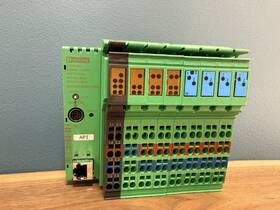
( Brand: Phoenix Contact ), ( Manufacturer Part Number: 2861247 ), ( Model: 24 8-PAC ), ( Type: Plc Input Module ), ( Communication Standard: Interbus ), ( Analog/digital: Digital )
Review PHOENIX CONTACT Ilc 131 Eth Inline Controller Ib Il Di Module
The **Phoenix Contact ILC 131 ETH 2700973 Inline Controller (2861247)** is a high-performance, modular industrial automation solution designed to deliver precise control, seamless integration, and robust scalability for modern manufacturing and process automation environments. This compact yet powerful inline controller combines Ethernet-based communication with an integrated **Intelligent Logic Controller (ILC)** architecture, enabling real-time monitoring, logic processing, and direct interfacing with field devices all while maintaining exceptional reliability in demanding industrial settings. Engineered with Phoenix Contact s signature precision engineering, the ILC 131 ETH is built to withstand harsh conditions, featuring a robust **IP67-rated enclosure** that protects against dust, moisture, and mechanical stress, ensuring uninterrupted operation in environments such as factory floors, oil and gas refineries, or automated packaging lines. Its **Ethernet (IEC 61158/61784 compliant)** connectivity allows for seamless integration into existing IT infrastructure, enabling bidirectional data exchange with higher-level systems like SCADA, MES, or cloud-based platforms, thereby facilitating advanced analytics, remote diagnostics, and predictive maintenance capabilities.
At the heart of the ILC 131 ETH is its **24V DC power supply**, which powers both the controller and the connected **8-channel PAC (Programmable Automation Controller) module (2700973)**, ensuring consistent performance across a wide range of industrial applications. The PAC module itself is a versatile addition, offering **8 discrete digital inputs (DI)** with configurable signal conditioning, including filtering and debouncing, to accommodate a variety of sensors and switches. These inputs are optimized for high-speed data acquisition, making them ideal for applications requiring precise timing, such as conveyor systems, machine synchronization, or safety-critical operations. The controller s **deterministic communication** via Ethernet ensures minimal latency, which is critical for applications demanding real-time responsiveness, such as CNC machine control or automated sorting systems. Additionally, the ILC 131 ETH supports **Phoenix Contact s ILC programming environment**, a user-friendly yet powerful tool that allows engineers to develop, simulate, and deploy logic programs with ease, reducing development time and minimizing errors.
Beyond its technical capabilities, the ILC 131 ETH excels in **scalability and flexibility**, allowing users to expand functionality as their automation needs evolve. The modular design enables the integration of additional PAC modules, such as analog inputs/outputs, relay outputs, or communication interfaces (e.g., PROFINET, EtherNet/IP), without requiring a complete system overhaul. This adaptability makes it an ideal choice for both small-scale automation projects and large-scale industrial installations where future-proofing is essential. The controller also supports **Phoenix Contact s ILC Safety** for integrated safety functions, ensuring compliance with international safety standards like ISO 13849 and IEC 62061, which is particularly valuable in applications where machine safety is paramount. With its **compact footprint**, the ILC 131 ETH is designed to fit seamlessly into tight spaces, reducing installation complexity while maximizing efficiency.
In summary, the **Phoenix Contact ILC 131 ETH 2700973 Inline Controller with 8-channel PAC module (2861247)** represents a cutting-edge solution for industrial automation, blending high-performance computing, robust connectivity, and modular flexibility into a single, reliable package. Whether deployed in a high-speed manufacturing line, a process control application, or a distributed automation network, this controller delivers the precision, scalability, and connectivity required to optimize productivity, enhance operational visibility, and ensure long-term reliability in even the most demanding industrial environments. Its combination of Ethernet-based intelligence, deterministic control, and Phoenix Contact s proven quality engineering makes it a standout choice for engineers and automation specialists seeking a future-ready control solution.
### **Phoenix Contact ILC 131 ETH 2700973 Inline Controller (2861247) with IB 24 DI/8-PAC Module: Pros and Cons**
#### **Pros**
1. **Modular and Scalable Design**
The ILC 131 series is part of Phoenix Contact s modular inline controller platform, allowing for easy expansion. You can add additional modules (input/output, communication, or power supply) as your system requirements grow without replacing the entire controller. This reduces long-term costs and simplifies upgrades.
2. **High Reliability and Industrial-Grade Build**
Phoenix Contact is a well-established brand known for robust, long-lasting industrial automation components. The ILC 131 is designed for harsh environments, with features like:
- Wide operating temperature range (-40 C to 70 C).
- Protection against electrical surges, EMI/EMC interference, and mechanical stress.
- Compact yet durable housing, making it suitable for embedded or space-constrained applications.
3. **Flexible Communication Options**
The **ETH (Ethernet) version** supports standard industrial protocols such as:- **Modbus TCP** (for easy integration with PLCs, SCADA, or HMIs).
- **Profinet** (via optional modules, if needed).
- **Ethernet/IP** (with additional configuration).
This makes it compatible with most modern automation systems without requiring proprietary solutions.
4. **Integrated Power Supply**
The inline controller includes an integrated power supply (24V DC or 120/230V AC, depending on the variant), reducing the need for external power modules and simplifying wiring.
5. **Easy Programming and Configuration**
Phoenix Contact provides **Phoenix Contact Automation Studio (PCAS)** or **TIA Portal** (Siemens-compatible) for programming. The software is user-friendly, with drag-and-drop functionality for logic control, making it accessible for engineers with varying levels of expertise.
- Supports **ladder logic (IEC 61131-3)**.
- Can be programmed for simple control tasks or more complex automation sequences.
6. **Compact and Space-Efficient**
The inline design allows for direct integration into panels or machinery, saving space compared to traditional rack-mounted controllers. This is particularly useful in retrofitting or constrained installations.
7. **Good Documentation and Support**
Phoenix Contact offers extensive technical documentation, including wiring diagrams, datasheets, and application examples. Their customer support is generally reliable, with access to regional distributors and technical hotlines.
8. **Cost-Effective for Small to Medium Control Tasks**
For applications requiring **8 digital inputs (DI) and 8 programmable outputs (PAC programmable analog contacts)**, this module provides a balanced solution without the complexity (or cost) of a full PLC. It s ideal for:
- Machine control (e.g., pumps, conveyors, packaging machines).
- Building automation (HVAC, lighting control).
- Process automation (where simple logic is sufficient).
9. **Compatibility with Phoenix Contact Ecosystem**
If you already use other Phoenix Contact products (e.g., terminal blocks, sensors, or power supplies), this controller integrates seamlessly, reducing compatibility issues and streamlining inventory management.
10. **Long-Term Availability**
Phoenix Contact products are known for their long product lifecycles, meaning parts and support are likely to remain available for years, reducing the risk of obsolescence.
---
#### **Cons**
1. **Limited Processing Power for Complex Tasks**
The ILC 131 is **not a full-fledged PLC** it lacks advanced features such as:- High-speed counters (beyond basic pulse counting).
- Advanced motion control (e.g., servo or stepper motor drives).
- Built-in safety functions (e.g., SIL-rated outputs).
- Large memory for extensive logic programs.
If your application requires **real-time motion control, high-speed data acquisition, or safety-critical functions**, this controller may be insufficient and require a more powerful PLC (e.g., Siemens S7-1200, Allen-Bradley Micro800, or Beckhoff TwinCAT).
2. **Programming Limitations**
While PCAS is user-friendly, it lacks some advanced features found in enterprise PLC software (e.g., **Structured Text debugging tools, advanced math functions, or built-in trend logging**). For simple logic, it works well, but for complex algorithms or data processing, you may need to offload tasks to a higher-level controller.
3. **No Built-In Analog Inputs/Outputs**
The **IB 24 DI/8-PAC module** only provides **digital inputs and programmable analog contacts (PAC)**. If your application requires **actual analog signals (e.g., temperature sensors, pressure transducers)**, you ll need to purchase additional modules (e.g., **AI 24 analog input module**), increasing cost and complexity.
4. **Dependence on Phoenix Contact Software**
If you re already invested in a different automation ecosystem (e.g., **Rockwell Automation, Siemens TIA Portal, or Codesys**), the learning curve for Phoenix Contact s software may be a drawback. Migration from another system could require re-programming.
5. **Limited Expansion Beyond Phoenix Contact**
While the controller supports **Modbus TCP and Ethernet**, integrating with non-Phoenix Contact devices may require additional configuration. Some third-party protocols (e.g., **Profinet, EtherNet/IP with advanced features**) may need optional modules or third-party drivers.
6. **Potential Overkill for Very Simple Applications**
If your control logic is **extremely basic** (e.g., a single relay replacement or a few sensor inputs), a **dedicated relay controller or even a PLC with fewer I/O points** might be more cost-effective. The ILC 131 is best suited for applications requiring **some programming flexibility** rather than purely mechanical relay logic.
7. **No Built-In HMI or Web Server**
Unlike some PLCs (e.g., Siemens S7-1200 with built-in HMI capabilities), the ILC 131 does not include a **local display or web server** for direct monitoring. You ll need to connect to an external HMI or SCADA system for visualization.
8. **Wiring Complexity for Mixed Signals**
If your application requires **both digital and analog signals**, you ll need to purchase additional modules, which can increase wiring complexity. The inline design is neat, but managing multiple modules side-by-side may require careful panel layout planning.
9. **Limited Global Support Outside Europe**
While Phoenix Contact has a strong presence in Europe and North America, support and local distributors may be less accessible in some regions, potentially affecting response times for technical issues or spare parts.
10. **No Built-In Diagnostics for Advanced Troubleshooting**
Compared to high-end PLCs, the ILC 131 has **basic diagnostics**. Advanced fault logging, predictive maintenance features, or deep error tracing may require additional software or external tools.
---
### **Conclusion**
The **Phoenix Contact ILC 131 ETH 2700973 with IB 24 DI/8-PAC module** is a **solid choice for applications requiring a compact, modular, and Ethernet-enabled controller with digital I/O and basic programming capabilities**. It excels in scenarios where:
- You need **scalability** without replacing the entire system.
- Your environment is **industrial-grade** (harsh conditions, vibration, temperature extremes).
- You require **Modbus TCP or simple Ethernet communication**.
- The control logic is **not overly complex** (ladder logic, basic sequencing, or sensor monitoring).
- You re already using **Phoenix Contact products** and want seamless integration.
However, it is **not ideal** if:- You need **high-speed motion control, advanced analog processing, or safety-rated outputs**.
- Your application requires **complex data logging, trend analysis, or enterprise-level SCADA integration**.
- You prefer **a more established PLC ecosystem** (e.g., Siemens, Allen-Bradley) with broader software support.
- Your budget is tight for **simple relay replacements**, as a dedicated controller may be overkill.
---
### **Recommendation**
**Buy the Phoenix Contact ILC 131 ETH 2700973 with IB 24 DI/8-PAC module if:**You need a **compact, Ethernet-enabled controller** for **digital I/O and basic logic control**.
Your application is **not safety-critical** and does not require advanced motion or analog processing.
You value **modularity and long-term reliability** in an industrial setting.
You are already using **Phoenix Contact components** or prefer their software ecosystem.
The **cost is justified** by the system s scalability and ease of integration.
**Consider alternatives if:**You require **high-speed counters, analog I/O, or safety functions** Opt for a **Siemens S7-1200, Allen-Bradley Micro800, or Beckhoff TwinCAT**.
Your project is **extremely simple** (e.g., a few relays) A **dedicated relay controller or PLC with fewer I/O points** may suffice.
You need **deep integration with Rockwell Automation or Codesys** A **third-party PLC** may offer better compatibility.
Budget is a **major constraint** Compare with **low-cost PLCs** (e.g., Keyence NC1
Details:
Includes exactly what is shown in the photos. Phoenix Contact ILC 131 ETH Inline Controller 2700973 with IB IL 24 DI 8-PAC module in excellent condition. Unit is in ideal cosmetic and working condition with no cracks or damage.
part #: 2861247 prices
- $200.00-$320.00
specifications sensoindustria:
- brand: Phoenix Contact
- mpn: 2861247
- model: 24 8-pac
- type: Plc Input Module
- communication standard: Interbus
- analog/digital: Digital
general sensoindustria:
- condition: Used
- PLCs HMIs > PLC Peripheral Modules > PLC Input Output Modules
payments sensoindustria:
- wallet: Apple-pay
- credit card: Discover
- money order
- other
offer sensoindustria:
- best offers: True
- quantity: 1
- options: Ship-to-home
- availability: In Stock
- sold: 0
- started: May 26, 2026
seller sensoindustria:
- city: Omaha, Nebraska
- rating: 100.0%
- # reviews: 29
returns sensoindustria:
- policy: No Returns
shipping sensoindustria:
- transit: 3-7 Days
- service: USPS Ground Advantage
- cost: $0.00
- type: Calculated
- class: Standard
- carrier: USPS
Phoenix Contact 2861247 Is Similar To:
- 2281050 Phoenix Contact Lot Of (32.8% similar) Capeskin secure 1000 this item has been fully tested by our tech department and is in good working condition EE4B...(January 6th, 2018)
- 2315269 Phoenix Contact New Interface (40.7% similar) 4MM our listings include many detailed photos. Items are not returnable for condition issues commented on or shown in the pictures. Please with any questions or concerns. Vb industrial supply offers a huge selection of tools for every trade including new and used electrical, mechanical, machinist ...(November 14th, 2017)
- 2688035 Phoenix Contact Axl Di (34.5% similar) Phoenix Contact axle di 32 1 exiling f digital input module 24VDC thumbnails to - new in original sealed box. Is the refurbishing and liquidation for one of countries leading leasing agents computer equipment. Please feel free to ask any questions or make an offer. In an effort to keep their ...(September 28th, 2017)
- 2688051 Phoenix Contact Axl Do Digital Out Module Axioline (40.3% similar) You can through messages. In an effort to keep their equipment up date, most large corporations turn perfectly good computer at the end of lease. Is the refurbishing and liquidation for one of countries leading leasing agents computer equipment. Phoenix Contact axle do 32 1 digital out module ...(May 17th, 2018)
- 2688077 Phoenix Contact Axioline Axl (36.1% similar) You can through messages. See images for items detailed condition. Is the refurbishing and liquidation for one of countries leading leasing agents computer equipment. In original box. Phoenix exiling axle f RTD8 1f analog input temperature I o module thumbnails to - item has been removed from box ...(September 28th, 2017)
- 2688158 Phoenix Contact Axioline Axl Di Digital Input Module Station (44.2% similar) In an effort to keep their equipment up date, most large corporations turn perfectly good computer at the end of lease. Missing one of the metal spring clips on bottom. See images for items detailed condition. Please feel free to ask any questions or make an offer. Is the refurbishing and ...(June 14th, 2018)
- 2724928 Phoenix Contact Ib Stme (34.2% similar) Need it urgently. Next day second air services are available. We choose the carrier. Domestic shipping price is shown for us lower 48 states. We get hundreds of items in daily, if don't have it today check back tomorrow. After the return period has ended, you can no longer product...(November 10th, 2017)
- 2726272 Phoenix Contact Interbus Inline Digital (45.1% similar) In order to give you the lowest possible rate, we combine shipping charges on multiple orders. Phoenix Contact interbus inline digital output terminal module...(March 1st, 2017)
- 2736453 Phoenix Contact Flm Ai (32.8% similar) Is the refurbishing and liquidation for one of countries leading leasing agents computer equipment. You can through messages. In an effort to keep their equipment up date, most large corporations turn perfectly good computer at the end of lease. See images for items detailed condition. Item has some...(September 28th, 2017)
- 2751687 Phoenix Contact Ib Stme (34.2% similar) We choose the carrier. Domestic shipping price is shown for us lower 48 states. We get hundreds of items in daily, if don't have it today check back tomorrow. Need it urgently. Next day second air services are available. After the return period has ended, you can no longer product...(November 10th, 2017)
- 2751836 Phoenix Contact Ib Stme (34.2% similar) Domestic shipping price is shown for us lower 48 states. After the return period has ended, you can no longer product. We get hundreds of items in daily, if don't have it today check back tomorrow. Need it urgently. Next day second air services are available. We choose the carrier...(November 10th, 2017)
