MAN ROLAND 16.85432-0003 Plc Register Interface Module RI-2 I/o
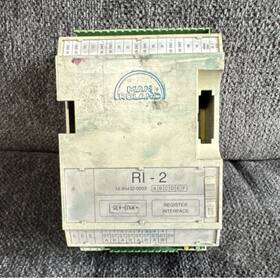
( Brand: Man Roland ), ( Manufacturer Part Number: 16.85432-0003 ), ( Model: RI-2 ), ( Part Type: Module )
Review MAN ROLAND Plc I/o Register Interface Module
The **Roland RI-2 PLC I/O Register Interface Module (Part No. 16.85432-0003)** is a high-performance, versatile communication interface designed to seamlessly bridge industrial automation systems with programmable logic controllers (PLCs) and other industrial equipment. Engineered for reliability and precision, this module serves as a critical link between field devices, such as sensors, actuators, and human-machine interfaces (HMIs), and the central control logic of a PLC, enabling real-time data exchange and process automation. Built with Roland s signature attention to engineering excellence, the RI-2 module supports a wide range of communication protocols, including Modbus RTU, Modbus ASCII, and proprietary serial interfaces, making it an adaptable solution for diverse industrial applications. Its robust construction ensures durability in demanding environments, with features such as galvanic isolation, robust shielding, and compliance with strict industrial standards like IEC 61131-2 and CE marking, guaranteeing both safety and performance in harsh operational conditions.
At its core, the RI-2 module operates as a bidirectional register interface, allowing for the seamless transfer of input and output signals between the PLC and external devices. This functionality is particularly valuable in scenarios where direct I/O expansion is required without the need for additional hardware, reducing complexity and lowering system costs. The module s compact yet sturdy design ensures easy integration into existing control panels or enclosures, while its modular architecture allows for flexible configuration based on specific application needs. Whether deployed in manufacturing plants, process control systems, or building automation networks, the RI-2 module delivers consistent and dependable communication, minimizing latency and maximizing efficiency in data acquisition and control signal transmission.
For engineers and technicians, the RI-2 offers a user-friendly interface with clear documentation and straightforward wiring instructions, simplifying installation and troubleshooting. Its compatibility with major PLC brands, including those from Siemens, Allen-Bradley, and Mitsubishi, further enhances its versatility, making it a preferred choice for system integrators and end-users alike. Additionally, the module s support for both discrete and analog signals via configurable registers ensures broad applicability across a spectrum of industrial processes, from discrete motion control to continuous process monitoring. With its blend of technical sophistication and practical usability, the Roland RI-2 PLC I/O Register Interface Module stands as a dependable asset in modern industrial automation, driving efficiency and reliability in complex control systems.
The Roland RI-2 PLC I/O Register Interface Module (part number 16.85432-0003) is a specialized device designed to bridge communication between Roland s industrial machines (such as CNC routers, laser cutters, or milling machines) and external PLCs (Programmable Logic Controllers). Below is a detailed breakdown of its pros and cons, followed by a conclusion and recommendation.
---
### **Pros of the Roland RI-2 Module**
1. **Seamless Integration with Roland Machines**
The module is specifically designed for Roland s CNC and laser systems, ensuring compatibility with their proprietary communication protocols. This eliminates the need for third-party adapters or complex middleware, reducing setup time and potential compatibility issues.
2. **Enhanced PLC Control Capabilities**
It allows for direct communication between Roland machines and external PLCs (e.g., Siemens, Allen-Bradley, or Mitsubishi), enabling automated workflows, real-time monitoring, and synchronized operations. This is particularly useful in industrial settings where machines must interact with larger control systems.
3. **Bidirectional Data Exchange**
The module supports both input and output signals, allowing the PLC to send commands to the Roland machine (e.g., start/stop, tool changes, or feed rate adjustments) and receive feedback (e.g., machine status, error codes, or sensor data). This two-way communication is critical for closed-loop control systems.
4. **Modular and Scalable**
Roland s RI-2 series is modular, meaning it can be expanded or configured to handle additional I/O points as needed. This scalability makes it suitable for growing operations or complex setups requiring multiple interfaces.
5. **Reduced Wiring Complexity**
By centralizing I/O communication through the RI-2, it can simplify wiring between the machine and PLC, reducing the number of direct connections and potential points of failure. This also lowers the risk of signal noise or interference.
6. **Support for Advanced Automation**
The module enables features like:- **Automated job sequencing** (e.g., loading parts, running multiple machines in tandem).
- **Real-time error handling** (e.g., stopping the machine if a PLC-detected issue arises).
- **Integration with MES/ERP systems** for tracking production data.
This is valuable for manufacturers aiming to optimize efficiency and reduce downtime.
7. **Documentation and Technical Support**
Roland provides detailed documentation and technical support for their RI-2 modules, which can be helpful for troubleshooting or custom configurations. Their reputation in the CNC/laser industry also suggests reliability in hardware design.
8. **Future-Proofing**
As Roland continues to update its software and firmware, the RI-2 module may receive compatibility improvements or new features, ensuring long-term usability.
---
### **Cons of the Roland RI-2 Module**
1. **Limited to Roland Machines**
The module is **not universal** it will only work with Roland s CNC routers, laser cutters, or milling machines. If you re using non-Roland equipment, this module is irrelevant, and you d need a different interface (e.g., Ethernet/IP, Modbus, or Profibus adapters).
2. **Potential Learning Curve**
Configuring the RI-2 to work with a specific PLC (especially non-Roland brands) may require programming knowledge (e.g., ladder logic, PLC tags, or communication protocols like Modbus TCP). Users unfamiliar with PLC programming might need to hire an engineer or spend time learning.
3. **Cost**
The RI-2 module is a **specialized piece of hardware**, and while not excessively expensive, it adds to the overall cost of automation. For small shops or one-off projects, the investment may not be justified. Pricing can vary, but expect to pay **$500 $1,500 ** depending on configuration and quantity.
4. **Dependence on Roland s Software**
The module relies on Roland s machine control software (e.g., Roland CNC Software, LaserGRAPHIC) to function properly. If the software is outdated, unstable, or lacks certain features, the RI-2 s capabilities may be limited. Upgrades to Roland s software may also require additional licensing.
5. **Physical Installation Constraints**
The module requires proper wiring and placement near the machine and PLC. Poor installation (e.g., insufficient shielding, long cable runs, or improper grounding) can lead to signal degradation or communication errors. This may necessitate additional hardware (e.g., signal conditioners) or professional installation.
6. **Compatibility Gaps with Some PLCs**
While the RI-2 supports common PLC brands, **not all PLCs may integrate flawlessly**. For example:- Some older PLCs may lack the necessary communication ports (e.g., Ethernet, RS-232).
- Custom PLC configurations (e.g., unique tag naming or protocol settings) might require additional development work.
Testing and validation may be required before full deployment.
7. **Maintenance and Spare Parts**
As a niche product, spare parts or replacements for the RI-2 may not be as readily available as off-the-shelf PLC components. Roland s support may take longer to respond compared to larger PLC manufacturers.
8. **Overkill for Simple Applications**
If your use case is basic (e.g., manually triggering a Roland machine from a PLC without real-time feedback), the RI-2 may offer more functionality than needed. In such cases, a simpler interface (e.g., a relay module or a basic serial adapter) could suffice at a lower cost.
---
### **Conclusion**
The Roland RI-2 PLC I/O Register Interface Module is a **highly specialized tool** tailored for advanced automation between Roland machines and external PLCs. It excels in scenarios where **real-time bidirectional control, scalability, and seamless integration** are priorities such as in industrial manufacturing, automated production lines, or complex CNC/laser setups requiring PLC coordination.
However, it is **not a one-size-fits-all solution**. Its value depends on whether you re already invested in Roland s ecosystem and need robust PLC integration. For users without existing Roland machines, the cost and complexity may not justify the purchase. Additionally, those without PLC programming experience may find setup challenging.
If your goal is **basic machine control** (e.g., start/stop signals) or you re using non-Roland equipment, alternative interfaces (e.g., Modbus converters, Ethernet adapters, or universal PLC I/O modules) might be more practical.
---
### **Recommendation**
**Buy the Roland RI-2 if:**- You are using **Roland CNC routers, laser cutters, or milling machines** and need **advanced PLC integration** (e.g., automated workflows, real-time monitoring, or synchronized operations).
- Your PLC is **compatible** (e.g., Siemens, Allen-Bradley, Mitsubishi) and you have the technical expertise (or support) to configure it.
- You require **bidirectional communication** (machine-to-PLC and PLC-to-machine) and plan to scale your automation in the future.
- You value **Roland s proprietary support** and are willing to invest in a specialized solution for long-term reliability.
**Avoid the Roland RI-2 if:**- You re using **non-Roland machines** and need a universal solution.
- Your automation needs are **simple** (e.g., basic on/off signals) and a cheaper, off-the-shelf interface would suffice.
- You lack **PLC programming knowledge** or access to technical support for configuration.
- Your budget is tight, and you can achieve similar results with **alternative, more affordable interfaces** (e.g., Modbus converters, serial adapters).
**Alternatives to Consider:**- **Modbus/TCP or RS-232 Adapters:** If your PLC supports Modbus, a generic Modbus converter (e.g., from WAGO, Advantech, or AutomationDirect) may be cheaper and more flexible.
- **Ethernet/IP or Profibus Modules:** For PLCs using these protocols, third-party modules (e.g., from Rockwell or Siemens) might offer better compatibility.
- **Universal PLC I/O Modules:** Brands like **Siemens, Allen-Bradley, or Mitsubishi** offer their own I/O modules that may integrate more seamlessly with their systems.
**Final Suggestion:**If you re committed to Roland s ecosystem and need **high-level automation**, the RI-2 is a strong choice. However, **test compatibility with your specific PLC** and consult Roland s documentation or a certified integrator to ensure a smooth setup. If in doubt, start with a **simpler interface** and upgrade later if needs evolve.
Details:
Man Roland RI-2 PLC I/O Register Interface Module 16.85432-0003.
part #: 16854320003 prices
- $99.99-$169.00
specifications sensoindustria:
- brand: Man Roland
- mpn: 16.85432-0003
- model: Ri-2
- part type: Module
general sensoindustria:
- PLCs HMIs > PLC Peripheral Modules > PLC Input Output Modules
- condition: Used
payments sensoindustria:
- wallet: Paypal
- other
- credit card: Mastercard
shipping sensoindustria:
- service: USPS Ground Advantage
- carrier: USPS
- class: Standard
- cost: $8.13
- transit: 4-10 Days
- type: Calculated
seller sensoindustria:
- city: Pueblo, Colorado
- # reviews: 5
- rating: 0.0%
returns sensoindustria:
- policy: No Returns
offer sensoindustria:
- best offers: True
- options: Ship-to-home
- sold: 0
- quantity: 1
- started: May 4, 2026
- availability: In Stock
Man Roland 16.85432-0003 Is Similar To:
- Man Roland Ips.lba-1 Ipslba1 Used Tested Cleaned (40.7% similar) Sells new and surplus product develops channels to purchase such. All products are guaranteed to be working but may show signs of use. Packaging and handling: items are safely eds packaged in custom shipping cartons for protection. Call to use a shipping service other than the ones listed...(August 9th, 2024)
- Man Roland Ips.do-1c 16.86926-0068 I o Module 24vdc Preowned (48.8% similar) Man Roland IPS.DO-1C 16.86926-0068 i/o module, 24VDC preowned...(August 25th, 2024)
- Man Roland Ips.aio-1 Used Analog I o Module (50.9% similar) Model: IPS.AIO-1. Condition: used. Part number: 16.86923-0007. Data words: 1-4. Lot of Man Roland digital output module brand. Indent number: 127...(September 4th, 2024)
- Man Roland Ips.ba-2 Used Bus Adapter Module (49.1% similar) Data bytes: part number: 16.86958-0017. Condition: used. Model: IPS.BA-2. Indent number: 11. Lot of Man Roland bus adapter modules brand...(September 4th, 2024)
- Man Roland 12058 Used Ips.dio-3 Digital Input output Module (54.1% similar) Data words: indent number: 191. Lot of Man Roland digital i/o module brand. Condition: used. Model: IPS.DIO-3. Part number: 16.86926-0071...(September 4th, 2024)
- Man Roland Vme.mci-1 Pc Board Assembly Module 2 Coaxial Used (45.5% similar) VME.MCI-1 Man Roland PC board assembly module, 2 coaxial, 16.86132.0021. Is Man Roland VME.MCI-1 not the part you are wanting. For example, programmable logic controllers plc's, distributed control systems DC's's, human machine interface him's, variable speed drives BSD's, power supplies, pressure ...(January 19th, 2025)
- Roland Ips.di-1 Man Digital Input Module (50.5% similar) It is a perfect choice for those looking durable and reliable module their plc system. With its analog/digital designation, it is perfect for processing digital signals and sending them to the appropriate output. The module is designed for use in industrial automation and motion control systems, ...(March 16th, 2025)
- Man Roland Ips.dio-1c 16.86926-0067 I o Module (55% similar) Part #: Man Roland IPS.DIO-1C for sale...(March 18th, 2025)
- Man Roland Ips.mcu-1 16.86959-0009 Digital I o Module Used (56.2% similar) Shipping: shipping cost: is quoted as part of the sale. Alternate part number: 16.86959-0009. Is Man Roland IPS.MCU-1 not the part you are wanting. IPS.MCU-1 Man Roland 16.86959-0009, digital i/o module, motor control. For example, programmable logic controllers plc's, distributed control systems DC...(September 27th, 2025)
- Man Roland 3tf6844-0cf7 Used Siemens Motor Starter Contactor 630a 600vac (38% similar) Electrical rating: 630A / 600VAC. Short circuit rating: 42KA, 600V. Siemens motor starter / contractor brand. Hp ratings: 200HP 200V, 250HP 230V, 500HP 460V, 660HP 575V. Model #: 3TF6844-0CF7. Condition: used, missing one knock-out on the cover...(December 10th, 2025)
- Man Roland Bp.uc-1 Bpuc1 Used (29.8% similar) Packaging and handling: items are safely eds packaged in custom shipping cartons for protection. Sells new and surplus product develops channels to purchase such. Call to use a shipping service other than the ones listed. All products are guaranteed to be working but may show signs of use if ...(February 8th, 2026)
