SIEMENS 1511-1 Cpu S7-1500 6ES7511-1AK01-0AB0
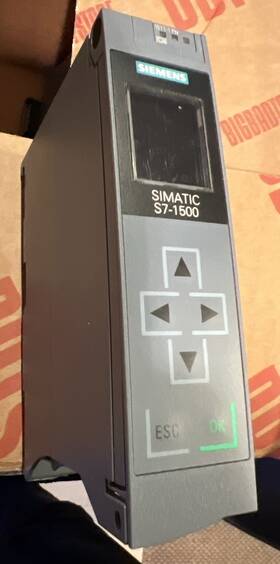
( Brand: Siemens ), ( Manufacturer Part Number: 1511-1 )
Review SIEMENS New Cpu Pn 6es7 511-1ak01-0ab0
The **Siemens SIMATIC S7-1500 CPU 1511-1 (6ES7 511-1AK01-0AB0 / 6ES7511-1AK01-0AB0)** is a high-performance, modular industrial controller designed to deliver robust automation solutions for demanding manufacturing, process control, and industrial applications. Part of Siemens advanced SIMATIC S7-1500 series, this CPU represents the pinnacle of scalability, flexibility, and integration capabilities, making it ideal for complex control systems requiring real-time processing, high-speed communication, and seamless connectivity with modern Industry 4.0 technologies.
At its core, the **1511-1 CPU** is engineered with a **dual-core ARM Cortex-A9 processor**, operating at a clock speed of up to **800 MHz**, ensuring rapid execution of control algorithms, data processing, and communication tasks with minimal latency. This computational power allows for the simultaneous handling of multiple high-priority tasks, including motion control, safety functions, and advanced analytics, all while maintaining deterministic performance a critical requirement in automated production lines and critical infrastructure applications. The CPU features **1 MB of integrated RAM (expandable via optional memory extensions)** and **4 MB of non-volatile storage**, providing ample space for program memory, data buffers, and system configurations, reducing the need for external storage solutions.
One of the standout features of the **1511-1** is its **built-in PROFINET interface (IEC 61158, IEC 62026-2)**, which enables high-speed, real-time communication with other Siemens devices, such as ET 200SP, ET 200M, or S7-1200/1500 CPUs, as well as third-party equipment supporting PROFINET IO or PROFINET CBA (Communication-Based Automation). This interface supports **up to 10 Mbps data transfer rates**, facilitating efficient data exchange for distributed I/O systems, motion control, and machine-to-machine (M2M) coordination. Additionally, the CPU includes **two integrated PROFIBUS DP ports (IEC 61158, IEC 61784-3)**, allowing seamless integration with legacy systems and enabling communication with field devices, PLCs, or other automation components via the robust PROFIBUS protocol. For expanded connectivity, the **1511-1** features **two Ethernet ports (RJ45)**, one of which supports **PROFINET**, while the other can be configured for **S7 Communication, OPC UA, or other industrial protocols**, ensuring compatibility with enterprise systems, SCADA platforms, and cloud-based solutions.
The **S7-1500 CPU 1511-1** is designed with **industrial durability in mind**, featuring a robust **industrial temperature range of -25 C to 60 C**, making it suitable for harsh environments such as manufacturing plants, oil and gas facilities, or outdoor installations. The unit is housed in a **compact, DIN-rail mountable enclosure (175 mm width)**, which simplifies installation in control panels or distributed control systems. To enhance reliability, the CPU includes **redundant power supply inputs (24 V DC)**, ensuring continuous operation even in the event of a single power source failure. Furthermore, the **1511-1** supports **hot-swappable memory modules**, allowing for seamless upgrades without disrupting ongoing processes, a feature that minimizes downtime in critical applications.
Security is a paramount consideration in modern industrial automation, and the **S7-1500 CPU 1511-1** incorporates **multiple layers of protection** to safeguard against cyber threats. It supports **SIMATIC NET security protocols**, including **TLS 1.2, IPsec, and certificate-based authentication**, ensuring encrypted communication between devices. The CPU also integrates with **SIMATIC Security Portal**, enabling centralized management of access rights, firmware updates, and vulnerability patches, thereby mitigating risks associated with unauthorized access or malware. Additionally, the **1511-1** adheres to **IEC 62443 industrial security standards**, providing a framework for secure system design and compliance with regulatory requirements.
For developers and engineers, the **S7-1500 CPU 1511-1** offers **comprehensive programming flexibility** through **TIA Portal**, Siemens unified engineering environment. This integrated development platform supports **S7-PLC, Structured Text (ST), Function Block Diagram (FBD), Ladder Logic (LD), and CFC (Continuous Function Chart)**, allowing programmers to choose the most efficient method for their application. The CPU also supports **SIMATIC WinCC OA (Open Architecture)** for advanced visualization and **SIMATIC PCS 7** for process automation, enabling seamless integration with higher-level supervisory systems. The **1511-1** further enhances productivity with **built-in diagnostics and error handling**, providing detailed logs, fault codes, and predictive maintenance alerts via **SIMATIC Diagnostics**, reducing troubleshooting time and improving system uptime.
In summary, the **Siemens SIMATIC S7-1500 CPU 1511-1 (6ES7 511-1AK01-0AB0 / 6ES7511-1AK01-0AB0)** is a versatile, high-performance industrial controller that excels in complex automation environments. With its **dual-core processing power, extensive communication interfaces, robust security features, and seamless integration with Siemens ecosystem of tools and devices**, it serves as a cornerstone for modern industrial control systems. Whether deployed in discrete manufacturing, process automation, or critical infrastructure applications, this CPU delivers **reliability, scalability, and future-proofing**, making it an indispensable asset for engineers and operators seeking to optimize efficiency and productivity in their automation solutions.
### **Pros and Cons of buying a Siemens S7-1500 CPU 6ES7 511-1AK01-0AB0 (6ES7511-1AK01-0AB0)**
#### **Pros**
1. **High Performance and Scalability**
- The **S7-1500** is Siemens latest generation of programmable logic controllers (PLCs), designed for industrial automation with improved processing power, memory, and communication capabilities compared to older models like the S7-300 or S7-1200.
- Supports **real-time control** with a **1.5 GHz ARM Cortex-A9 processor**, allowing for faster execution of logic and better handling of complex applications.
- **Modular expansion** additional memory (CPU extensions), analog/digital I/O, and communication modules can be added as needed, making it suitable for growing or complex automation systems.
2. **Enhanced Communication and Protocols**
- Built-in support for **PROFINET, Ethernet/IP, Modbus TCP, OPC UA, and other industrial protocols**, enabling seamless integration with SCADA systems, HMIs, and other PLCs.
- **High-speed Ethernet ports** (10/100/1000 Mbps) improve data transfer rates, reducing latency in distributed systems.
- **Wireless connectivity options** (via optional modules) allow for remote monitoring and control, useful in large or hard-to-wire environments.
3. **Advanced Safety and Security Features**
- **Safety-integrated functions** (e.g., **SIL 3/PL e compliant** safety modules) can be integrated directly, reducing the need for separate safety PLCs.
- **Secure boot and firmware validation** help prevent unauthorized code execution, mitigating risks from cyber threats.
- **TIA Portal integration** simplifies programming, debugging, and maintenance through a unified engineering environment.
4. **Energy Efficiency and Reliability**
- Designed with **low power consumption** compared to some legacy PLCs, reducing operational costs.
- **Robust industrial-grade components** ensure long-term reliability in harsh environments (temperature, vibration, EMI/EMC resistance).
5. **Future-Proofing and Software Support**
- **Long-term software support** from Siemens, with updates and compatibility with the latest versions of **TIA Portal V17 **.
- **Cloud connectivity options** (via Siemens MindSphere or third-party platforms) enable remote diagnostics, predictive maintenance, and IoT integration.
- **Compatibility with modern automation trends** such as digital twins, AI-driven analytics, and edge computing.
6. **User-Friendly Programming and Diagnostics**
- **TIA Portal** provides a **graphical, intuitive interface** for ladder logic (LAD), structured text (ST), function block diagrams (FBD), and other programming languages.
- **Enhanced diagnostics** with real-time monitoring, error logging, and remote troubleshooting capabilities.
- **Simplified I/O configuration** and **auto-detection** of connected modules reduce setup time.
7. **Cost-Effective for Large-Scale Applications**
- While the upfront cost is higher than entry-level PLCs (e.g., S7-1200), its **performance, scalability, and longevity** often justify the investment for **mid-to-large industrial applications**.
- **Reduced lifecycle costs** due to lower maintenance needs, longer lifespan, and fewer downtime incidents.
---
#### **Cons**
1. **High Initial Cost**
- The **S7-1500 CPU 6ES7 511-1AK01-0AB0** is significantly more expensive than older Siemens PLCs (e.g., S7-300, S7-1200) or competitors like **Allen-Bradley (Rockwell Automation) CompactLogix or ControlLogix**.
- Additional costs may arise from **licensing TIA Portal** (if not already available) and **expansion modules** for specific I/O or communication needs.
2. **Complexity for Small or Simple Applications**
- Overkill for **small-scale or low-budget automation projects** where a **S7-1200 or even a basic S7-200** would suffice.
- **Steeper learning curve** for engineers unfamiliar with **TIA Portal** or advanced PLC programming.
3. **Dependency on Siemens Ecosystem**
- **Vendor lock-in risk** while Siemens supports open protocols (PROFINET, Modbus, OPC UA), some proprietary features may limit flexibility if migrating to other brands.
- **Limited third-party support** compared to more open platforms (e.g., Allen-Bradley s extensive ecosystem).
4. **Potential for Overkill in Some Use Cases**
- If the application **does not require high-speed processing, extensive I/O, or advanced safety features**, the **S7-1500 may be unnecessarily powerful**, leading to wasted resources.
- **Higher power consumption** than some lower-end PLCs, which may be a concern in energy-sensitive applications.
5. **Licensing and Software Costs**
- **TIA Portal is not free** while Siemens offers free trials, full licensing is required for commercial use, adding to the total cost of ownership.
- **Optional advanced features** (e.g., safety modules, cloud integration) may require additional licenses or hardware.
6. **Availability and Lead Times**
- **Newer models may have longer lead times** compared to older, more established PLCs.
- **Used/refurbished units** may be harder to source with full warranty support, increasing risk.
7. **Maintenance and Training Requirements**
- **Requires trained personnel** familiar with **TIA Portal, PROFINET, and industrial networking** training may be necessary for in-house teams.
- **Firmware updates** must be managed carefully to avoid compatibility issues with existing systems.
---
### **Conclusion**
The **Siemens S7-1500 CPU 6ES7 511-1AK01-0AB0** is a **high-performance, scalable, and future-proof PLC** ideal for **large industrial automation projects** requiring **real-time control, advanced safety, and robust communication**. Its **superior processing power, modularity, and integration with TIA Portal** make it a strong choice for **manufacturing, process control, and complex distributed systems**.
However, for **smaller applications, budget-conscious projects, or environments where simplicity is prioritized**, the **S7-1200 or even a third-party PLC (e.g., Allen-Bradley CompactLogix)** may be more cost-effective. The **high upfront cost, dependency on Siemens ecosystem, and learning curve** should be carefully considered before purchasing.
### **Recommendation**
- **Buy the S7-1500 CPU 6ES7 511-1AK01-0AB0 if:**- You are implementing a **large-scale automation system** requiring **high-speed processing, extensive I/O, and advanced safety features**.
- Your project involves **PROFINET, OPC UA, or cloud integration**, and you need **long-term Siemens support**.
- You plan to **scale the system in the future** and require **modular expansion capabilities**.
- Your team is **familiar with TIA Portal** or can undergo training.
- **Consider alternatives if:**- Your application is **small-scale or low-budget** opt for an **S7-1200 or S7-200** instead.
- You need **maximum flexibility and open standards** evaluate **Allen-Bradley (Rockwell Automation) or other PLC brands**.
- You require **lower power consumption or minimal initial investment** a **used/refurbished S7-300 or S7-400** might suffice.
- Your team lacks **experience with Siemens PLCs** training costs and learning time should be factored in.
**Final Verdict:** The **S7-1500 is a premium choice** for **industrial automation demanding high performance and scalability**, but it is **not the best fit for every application**. Assess your project s requirements carefully before committing to this PLC.
Details:
Working s7 1511 cpu as shown.
part #: 15111 prices
- $624.99-$800.00
specifications sensoindustria:
- brand: Siemens
- mpn: 1511-1
returns sensoindustria:
- policy: No Returns
offer sensoindustria:
- quantity: 1
- availability: In Stock
- options: Ship-to-home
- sold: 0
- started: February 7, 2026
seller sensoindustria:
- # reviews: 3582
- city: Mansfield, Massachusetts
- rating: 100.0%
shipping sensoindustria:
- cost: $13.38
- class: Expedited
- type: Calculated
- transit: 4-10 Days
- service: USPS Priority Mail
- carrier: USPS
general sensoindustria:
- condition: Used
- PLCs HMIs > PLC Peripheral Modules > PLC Input Output Modules
payments sensoindustria:
- credit card: Diners-club
- other
- wallet: Apple-pay
Siemens 1511-1 Is Similar To:
- 00370386-01 Siemens New Laser Light Barrier (26.1% similar) However, its simply not cost-effective to invest time money into fully testing some of our equipment therefore certain items are sold untested or as-is with no warranty. Item is new, however, the box packaging has been open to verify contents and obtain photos. You are looking at a new Siemens laser...(January 4th, 2017)
- 1fn1910-0aa20-3aa0 Siemens New In Sealed (30.4% similar) Siemens 1FN1910-0AA20-3AA0 new in sealed box...(June 14th, 2017)
- 2586234-0001 Siemens New Sealed Digital Output Module (28.8% similar) This part is newly sealed inside its oem box. All parts repair items sold are final sales. A 30-DAY warranty included...(October 1st, 2018)
- 2586234-0002 Siemens Module Digital Output Dc New In Box Nib (25.8% similar) Only 235 with free shipping anywhere in north America. For regions other than north America, please a shipping quote. You are buying the best of for a fraction cost. The in very good condition all as visible pictures. Siemens module digital output 2a dc new in box nib with free shipping is old stock...(November 10th, 2018)
- 25862410-0001 Siemens New Relay Output Module (29.1% similar) A 30-DAY warranty included. All parts repair items sold are final sales. This part is newly sealed inside its oem box...(October 1st, 2018)
- 2586265-0003 Siemens New Texas Instruments (26.3% similar) This item is new in original packaging from the manufacturer, opened for inspection by our QC department...(December 7th, 2017)
- 39vimccn Siemens New Voltage Input (28.3% similar) 02 dated 2013 FREE shipping in continental us. New Siemens 39VIMCCN voltage input module apace ROM...(November 18th, 2017)
- 3ra1921-1ba00 Siemens New Factory Sealed Module Dc 4011209516496 (26.5% similar) 3RA1921-1BA00 Siemens new factory sealed 3RA19211BA00 dc link module for size s0 as shown item location 11D...(June 29th, 2018)
- 3rg 3rg6155-3mm00 Siemens New Sonar (28% similar) Item is new and comes as pictured...(April 11th, 2017)
- 3rt1936-1cd00 Siemens New Surge Suppressor (31.6% similar) Siemens surge suppressor 3RT1936-1CD00127-240VAC 150-250VDCUNUSED, still in original packaging removed from box for picture...(August 15th, 2017)
- 3rv1021-1aa10 Siemens New Circuit Breaker (33.6% similar) New Siemens 3RV1021-1AA10 circuit breaker 3RV10211AA10 1753 ax call us anytime at...(May 16th, 2017)
